
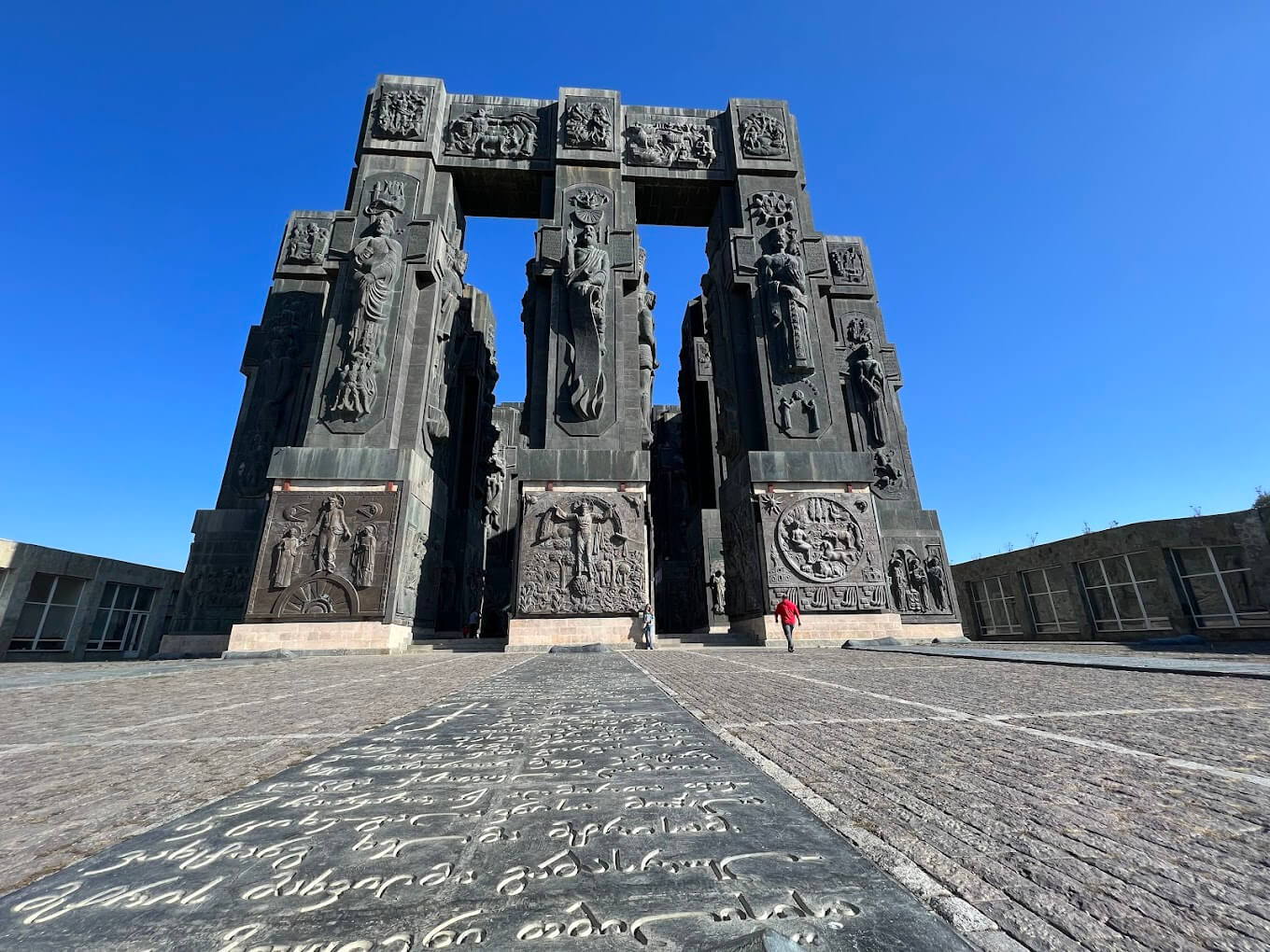
High above the Tbilisi Sea, on a quiet hilltop away from the city’s daily rhythm, stands one of the most enigmatic and under-visited monuments in the world: the Chronicles of Georgia. Equal parts fortress, cathedral, and sculpture garden, it has been called “Georgia’s Stonehenge” — and not without reason. Towering, silent, and unfinished, these stones hold more than just carvings. They hold a story.
The Monument’s Origins
The Chronicles of Georgia was commissioned and begun in 1985 by Zurab Tsereteli, a well-known Georgian-Russian sculptor and architect. Built during the waning years of the Soviet Union, it was intended to celebrate 3,000 years of Georgian statehood and 2,000 years of Christianity in Georgia.
Construction was never completed. The fall of the Soviet Union brought a halt to progress, and to this day scaffolding can still be seen around some of the towering 30–35 meter pillars. Despite its incomplete state, the monument has stood the test of time, continuing to draw curious travelers and spiritual seekers alike.
Symbolism in Stone
The structure consists of 16 colossal pillars arranged in a circle. The upper parts of the columns depict scenes of kings, queens, and notable figures from Georgian history — the builders of state and legacy. The lower parts depict events from the life of Christ: the Crucifixion, the Baptism, the Nativity, and the Resurrection, among others.
The floor beneath your feet tells stories too — with carved prayers and inscriptions like, “Jesus Christ – Son of God – Have Mercy on Us,” written in ancient Georgian script. Near the entrance, slabs honor Georgia’s monarchs. At the base of the hill, a small chapel whispers of silence and stillness, completing the site’s sacred geometry.
The Mystery and Legacy
The Chronicles of Georgia remains unfinished — and perhaps that’s part of its mystique. It invites interpretation. For some, it’s a national monument. For others, a forgotten Soviet relic. But many who visit feel something more: a quiet resonance that lingers in the air, as if the monument is still speaking.
Unlike tourist-packed landmarks, this site offers space for contemplation. The wind, the silence, the towering figures — all seem to say: this place is alive in ways that aren’t entirely visible.
How I View It
To me, the Chronicles of Georgia is more than a monument. It’s a transmission — a layered message carved in stone. Through the lens of a model I’ve come to call Triadic Consciousness Theory (TCT), the monument reflects a deep inner process: alignment between logic (the structure), emotion (the story), and awareness (the space it creates).
It doesn’t preach. It mirrors. It speaks — if you’re willing to listen with all three centers of being.
The Message of the Stones (For Fun)
“Let thought bow, let feeling rise, let presence speak.
Begin in surrender — not weakness, but alignment.”
“You walk upon memory. Let it inform, not define.
Identity is structure — not soul.”
“This is not just a monument. It’s a mirror.
What you see in it depends on who is seeing.”
“You will suffer. You will rise.
You are not the story — you are the light shining through it.”
“Leadership is not domination — it is aligned structure.
Be ruled by what is whole within you.”
“You are not done. Nor are these stones.
Evolution is eternal. Breathe into the unknown.”
Final Reflection We don’t always finish what we begin. But sometimes, what we leave unfinished becomes the most honest reflection of who we are becoming.
In that sense, the Chronicles of Georgia is not a relic — it’s a teacher. And its lesson may be different for everyone who stands before it. How you view life shapes it. 🙂