
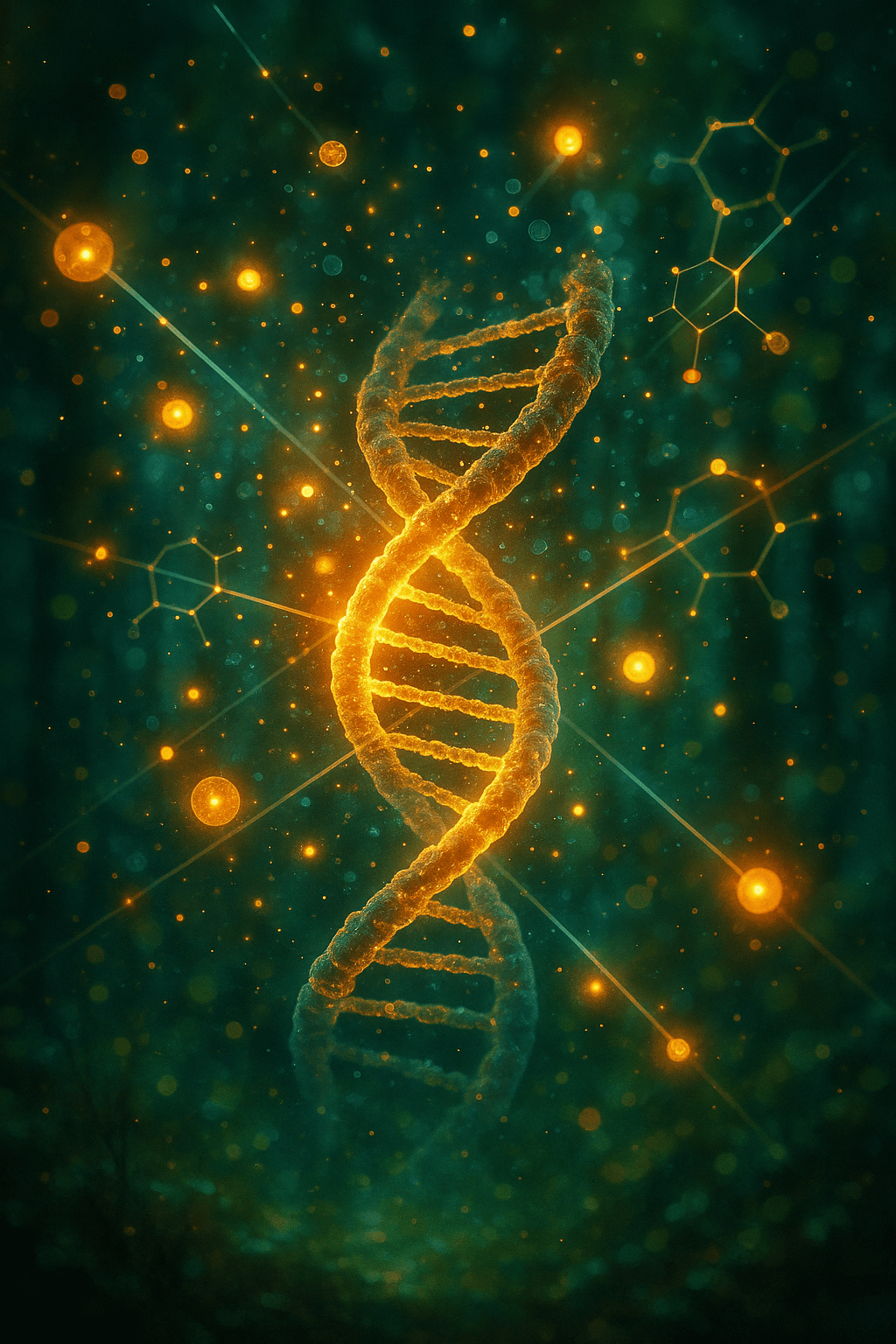
What Is Quantum Biology?
Quantum biology is a groundbreaking field that explores how quantum mechanics — the laws that govern particles smaller than atoms — apply to living organisms. While quantum physics is typically reserved for describing the behavior of electrons, photons, and atoms, quantum biology asks a profound question:
Could life itself rely on quantum phenomena to exist, adapt, and evolve?
This emerging science challenges the idea that biological processes can be fully explained by classical physics and chemistry alone. It proposes that quantum effects may play a role in some of the most mysterious and essential parts of life — from photosynthesis to brain activity.
Section 1: Key Quantum Concepts in Biology
Let’s break down the core ideas quantum biology draws from:
- Superposition: A particle can exist in multiple states at once until observed. Think: a protein that explores different shapes simultaneously before settling into the most functional one.
- Quantum Tunneling: Particles can pass through barriers they seemingly shouldn’t. Example: Protons in enzymes tunnel through energy barriers to speed up reactions.
- Entanglement: Two particles can be connected across distances, instantly affecting each other. This might help birds navigate using Earth’s magnetic field in a process called quantum coherence.
- Coherence: Quantum states that stay synchronized long enough to create order. In biology, coherence could allow cells or molecules to “share” information in a highly efficient way.
Section 2: Real-Life Examples of Quantum Biology
This isn’t just theory — here are some real and researched cases:
🧬 Photosynthesis
Plants and algae may use quantum coherence to transfer energy from sunlight with near-perfect efficiency.
🧲 Bird Navigation
Migratory birds like robins may “see” Earth’s magnetic field using quantum entanglement in proteins inside their eyes — specifically cryptochromes.
👃 Sense of Smell
Some scientists suggest we smell things not by shape alone, but through quantum vibrations of molecules.
🧠 Consciousness and the Brain
The controversial Orch-OR Theory (by Penrose & Hameroff) suggests that microtubules in brain cells might host quantum-level processes — possibly influencing thought, decision-making, or even consciousness.
Section 3: Why Quantum Biology Matters
Quantum biology isn’t just an intellectual curiosity — it could reshape how we understand:
- Healing and disease: Could illness be a breakdown in coherence at the quantum level?
- Consciousness: Is awareness tied to quantum processes?
- Artificial Intelligence: Can we mimic life’s quantum logic?
- Energy and sustainability: Learning from nature’s quantum efficiency (like in photosynthesis) could revolutionize clean energy.
This science sits at the edge of a paradigm shift — uniting physics, biology, and consciousness into one system.
Section 4: Controversy and Caution
Mainstream science still debates many aspects of quantum biology:
- Critics argue biology is too warm and wet for fragile quantum states to survive.
- Some experiments lack reproducibility — a key scientific standard.
- Quantum coherence has been observed, but direct evidence of quantum computation in cells is still rare.
Still, the field is gaining credibility with advances in technology, especially in quantum computing, neuroscience, and biophysics.
A New Lens on Life
Quantum biology invites us to look at life through a more subtle and powerful lens. It proposes that nature may have evolved to use quantum mechanics, not avoid it. If true, this means that consciousness, healing, intuition, and even evolution itself could have quantum undercurrents.
In a world where everything seems to separate us into compartments, quantum biology may be whispering:
“It’s all connected.”