
The Moment Between What Was and What Will Be
In the quantum world, nothing changes smoothly. Instead, change often happens through a transition state — a brief, high-energy point where the system is neither here nor there.
These are called quantum transition states, and they’re at the core of how particles react, evolve, and tunnel through barriers. In chemistry, they determine whether a molecule forms or breaks. In biology, they may shape processes like enzyme activity and DNA replication. And in speculative theory, they may even reflect how consciousness makes quantum-level “decisions.”
Let’s unpack what these transition states really are — and why they matter.
Section 1: What Is a Quantum Transition State?
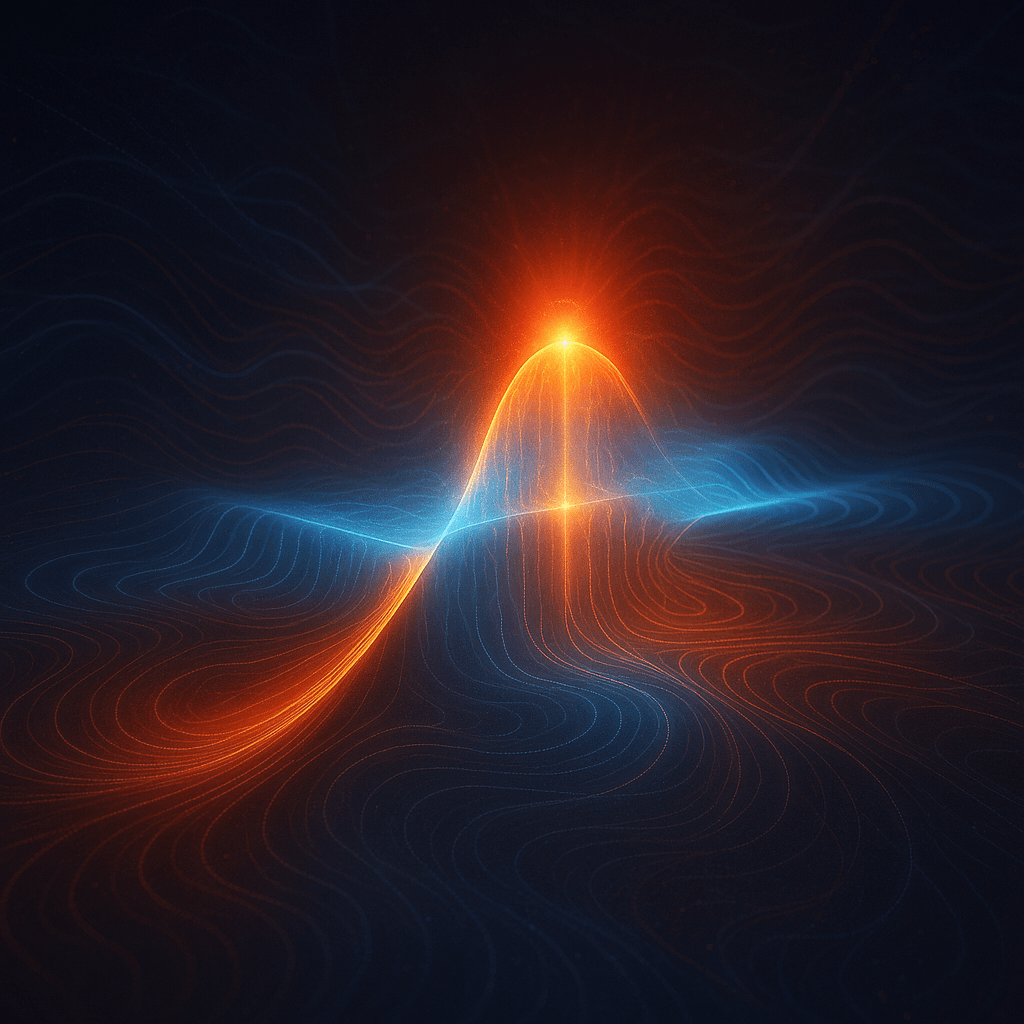
In quantum mechanics, a transition state is a brief, unstable configuration between two stable energy states. Think of it like this:
You’re rolling a ball over a hill. The top of the hill — the highest energy point — is the transition state.
In this state:
- The system is at a critical point of energy
- It exists for only femtoseconds (10⁻¹⁵ seconds)
- It’s usually undetectable directly, but its effects are massive
Quantum systems must pass through this energetic “gateway” to shift from one state to another.
Section 2: Quantum Tunneling and Transition States
Here’s where quantum physics gets wild. A particle doesn’t always have to go over the energy barrier — it can tunnel through it, even if it shouldn’t have the energy to do so.
This is known as quantum tunneling, and it’s tied to transition states in reactions where:
- Particles vanish from one side of a barrier
- And reappear on the other, skipping the classical path
In biology, this shows up in:
- Enzyme reactions
- Photosynthesis energy transfers
- Proton transfers in DNA base pairing
Section 3: Chemistry and Reaction Dynamics
In chemistry, a quantum transition state is the key to determining:
- The reaction rate
- Whether a chemical transformation will succeed
- The activation energy required
The entire field of Transition State Theory (TST) is based on this idea:
Molecules collide → reach a high-energy configuration (the transition state) → fall into products
What’s remarkable is that temperature, pressure, and even quantum interference can influence whether the system makes it through this “invisible gate.”
Section 4: Biological Implications — Quantum in the Body
Transition states don’t just exist in labs — your body uses them constantly.
Examples include:
- Enzymes lowering the energy of a transition state to speed up reactions
- Protein folding passing through complex energetic landscapes
- Molecular motors like ATP synthase using transition states to move energy
Some studies even suggest that the brain — through microtubules or ion channels — might be navigating quantum transitions during states of awareness or perception (a concept explored in the Orch-OR theory).
Section 5: Philosophical & Metaphysical Parallels
While grounded in science, quantum transition states mirror something more symbolic:
- The liminal space between choices
- The threshold between chaos and clarity
- The moment before transformation
Some theorists speculate that human decisions, intuition, or flashes of insight might arise from a brain operating near or through quantum thresholds.
While controversial, it aligns with the idea that “consciousness collapses the wave function” — i.e., awareness pushes a potential into reality.
So.. The Gateway That Shapes Reality
Quantum transition states are brief, invisible, and almost impossible to hold onto — yet they are crucial. They represent the fork in the road, the decision point that determines what happens next — whether in a molecule, a cell, or (maybe) your mind.
Understanding them teaches us that change is not smooth — it’s sharp, sudden, and full of energy.
And every transformation, at its core, requires that leap.