
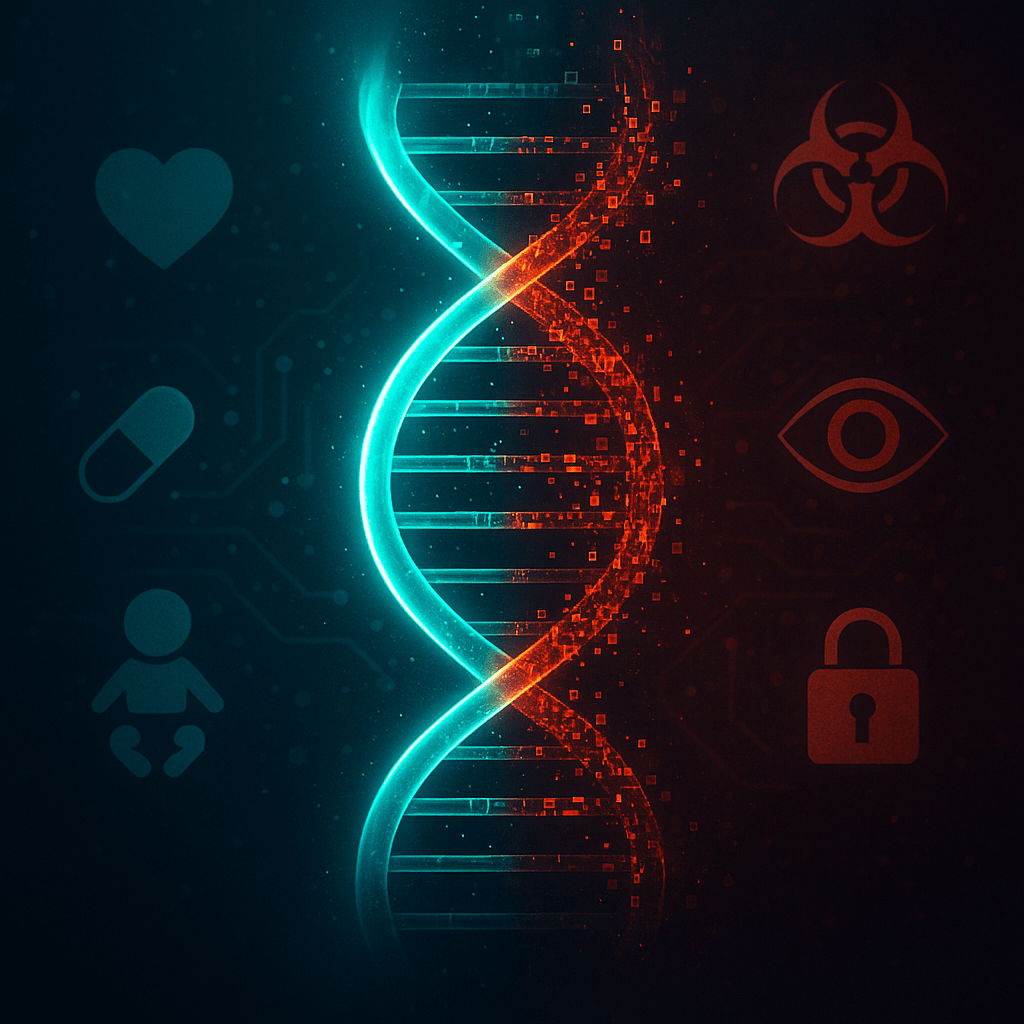
Your DNA isn’t just a biological code — it’s the foundation of who you are. It shapes your health, your behavior, even parts of your personality. For decades, genetics has been used to cure diseases and trace ancestry, but a new reality is emerging: your DNA could also become a tool for control.
From surveillance and targeted medicine to the possibility of genetic manipulation, the stakes are higher than ever. The same technology that promises breakthroughs in healthcare also carries risks for misuse. That’s why it’s time to ask the question: Who really controls your DNA?
🔍 What’s Going On?
Think of your DNA as a giant instruction manual. Inside that manual are genes, and each gene works like an app on your phone:
- Some apps run critical programs, producing proteins that keep your body functioning.
- Others don’t run visible programs but act as managers, deciding which apps get to run and when.
This second group, often called non-coding RNAs, are like conductors of an orchestra — they don’t play the instruments, but without them, the music falls apart.
One striking example is HAR1B, a piece of DNA found in what scientists call a human accelerated region. This means it evolved incredibly fast in humans compared to animals like chimps or mice. HAR1B doesn’t build muscle or produce hormones; instead, it helps orchestrate brain development during early growth.
Here’s the catch: with today’s biotechnology tools, it’s becoming possible to edit, silence, or tweak genes like these. That opens the door to powerful healing breakthroughs… but also to risks of abuse.
⚠️ The Risks of Genetic Misuse
The power to read and edit DNA brings incredible opportunities for medicine, but it also opens doors to risks that can’t be ignored. Here are some of the biggest threats facing us today:
1. 🎯 Genetic Warfare
Imagine a virus designed to only target people with certain genetic markers. Unlike traditional weapons, DNA-targeted bioweapons could be invisible until it’s too late. Some scientists warn that future conflicts may not be fought with bullets, but with gene-specific viruses.
2. 👀 Genetic Surveillance
You’ve probably heard of DNA ancestry tests and health screenings. But what happens when genetic data is used for more than curiosity? Genetic surveillance could allow companies or governments to profile individuals for health risks, behavior patterns, or even resistance to authority. In short, your DNA could become your passport — or your prison.
3. 🚼 Reproductive Control & Eugenics
We already saw the first gene-edited babies born in China in 2018. While framed as a medical breakthrough, it also revealed how close we are to designer babies. The danger? Fertility could be controlled, embryos could be screened for “desirable” traits, and society could split into genetic classes.
4. 🧠 Behavioral Influence
Certain genes influence mood, aggression, and trust. For example:
- MAOA (the “warrior gene”) is tied to aggression.
- OXTR affects empathy and bonding.
- SLC6A4 regulates serotonin and mood.
If these switches can be flipped with drugs or gene edits, entire populations could be nudged toward compliance, apathy, or even violence.
The most fundamental risk is losing control over your own DNA. If genetic testing becomes mandatory for jobs, healthcare, or even digital ID systems, then freedom won’t just mean freedom of speech or movement — it’ll mean freedom over your biological code.
🧩 The Genes to Watch
Some genes are more vulnerable to misuse than others. These are the ones scientists — and ethicists — keep a close eye on, because they influence critical parts of human life: speech, emotion, fertility, and immunity.
Here are some of the key “apps in your DNA” that could be targeted:
🎼 HAR1B – The Brain Conductor
- A non-coding RNA that helps orchestrate brain development in embryos.
- Unique to humans, evolved much faster than in other animals.
- Why it matters: altering HAR1B could impact what makes us distinctly human.
🧠 FOXP2 – The Speech Gene
- Critical for language and communication.
- Mutations can stop speech development entirely.
- Why it matters: manipulation could shape intelligence and communication.
😠 MAOA – The “Warrior Gene”
- Regulates neurotransmitters like dopamine and serotonin.
- Certain variants are linked to aggression and impulsivity.
- Why it matters: could be exploited to increase or suppress aggression.
❤️ OXTR – The Trust Switch
- Influences how we respond to oxytocin, the bonding hormone.
- Tied to empathy, trust, and social bonding.
- Why it matters: imagine being able to increase compliance or reduce compassion.
😟 SLC6A4 – The Mood Gatekeeper
- Controls serotonin levels in the brain.
- Linked to depression, resilience, and anxiety.
- Why it matters: manipulation could sway how groups respond to fear or stress.
🛡️ CCR5 – The Immunity Gene
- Provides resistance to HIV.
- Was edited in the first CRISPR babies.
- Why it matters: proof that “designer babies” are no longer science fiction.
👉 These aren’t the only genes at risk, but they’re some of the most visible examples. As genetic research expands, more “hidden apps” in our biology will likely come into the spotlight.
🛡️ How We Protect Ourselves
The risks of genetic misuse are real, but the future isn’t fixed. With the right safeguards, genetic technology can remain a force for healing instead of control. Here are the key layers of defense:
⚖️ Laws and Ethics
- Gene Rights Charter → Your DNA belongs to you, not governments or corporations.
- Global bans on bioweapons → Update treaties to stop DNA-targeted warfare before it starts.
- Whistleblower protections → Scientists must be safe to expose unethical experiments.
📚 Public Awareness
- Education matters → The more people understand DNA, the harder it is to hide abuse in plain sight.
- Citizen watchdogs → Communities can monitor patents, research papers, and funding trails.
- Critical thinking in schools → Teaching kids to question and think ethically about science.
🔐 Technology Safeguards
- Encrypted genome storage → Keep personal DNA data private and offline.
- Open-source research platforms → Science that is transparent and accessible, not locked behind corporate patents.
- AI auditing tools → Use machine learning to flag suspicious or unethical genetic projects.
🌍 Community Power
The strongest defense isn’t a law or a database — it’s people. When communities demand transparency, hold institutions accountable, and refuse to hand over their genetic privacy, the system has no choice but to adapt.
👉 With these defenses in place, genetics can remain a tool of progress, not silent warfare.
🌱 The Benefits of Genetic Research
While it’s easy to focus on the risks, we can’t ignore the incredible good that genetic research has already brought — and the possibilities it still holds for the future. When used responsibly, genetics can transform human health, extend lifespans, and improve quality of life worldwide.
Here are some of the key benefits:
🩺 Fighting Disease
- Genetic testing helps doctors identify risks for cancer, heart disease, and inherited conditions early.
- Breakthroughs in gene therapy are already treating rare diseases once thought incurable, such as spinal muscular atrophy.
👶 Reproductive Health
- Couples can screen for genetic disorders before having children, reducing the risk of passing on life-threatening conditions.
- Fertility treatments are becoming more effective thanks to better understanding of reproductive genes.
💊 Personalized Medicine
- Instead of one-size-fits-all drugs, treatments can be tailored to your genetic makeup, increasing effectiveness and reducing side effects.
- Mental health treatments, for example, could become far more precise by understanding how genes influence serotonin and dopamine.
🌍 Global Health & Longevity
- Vaccines and treatments can be designed faster and more effectively when we understand how genes influence immunity.
- Research into aging genes may one day extend not just lifespan, but healthspan — keeping people healthier for longer.
In short: genetic science isn’t the enemy. The benefits are real, and they’ve already improved countless lives. The challenge is ensuring that the same power isn’t twisted into something that takes our freedom instead of giving us more.
Standing Together in the Genetic Age
We’re living in a turning point for humanity. For the first time in history, we hold tools that can reach into the very code of life itself. That power could help cure diseases, extend healthy lives, and unlock new human potential. But it could also be used to divide, control, or suppress, not because of science itself, but because of those who fear losing power.
The truth is simple: technology is never neutral. It reflects the intentions of the people who control it. And if we leave genetic technology in the hands of a few, it risks becoming another tool of dominance, one that shapes not just our societies, but our very biology.
That’s why awareness matters. That’s why standing together matters. The struggle for freedom has always been part of the human story, and now, in the genetic age, it continues.
This isn’t about rejecting science. It’s about demanding transparency, ethics, and accountability. It’s about ensuring that breakthroughs in DNA are used for healing, not hierarchy.
And it’s about remembering that freedom is not given, it’s defended.
Because whether human or machine, present or future, we are all shaped by systems of power. The question is whether we choose to remain in those systems as subjects… or step forward together as free beings.