
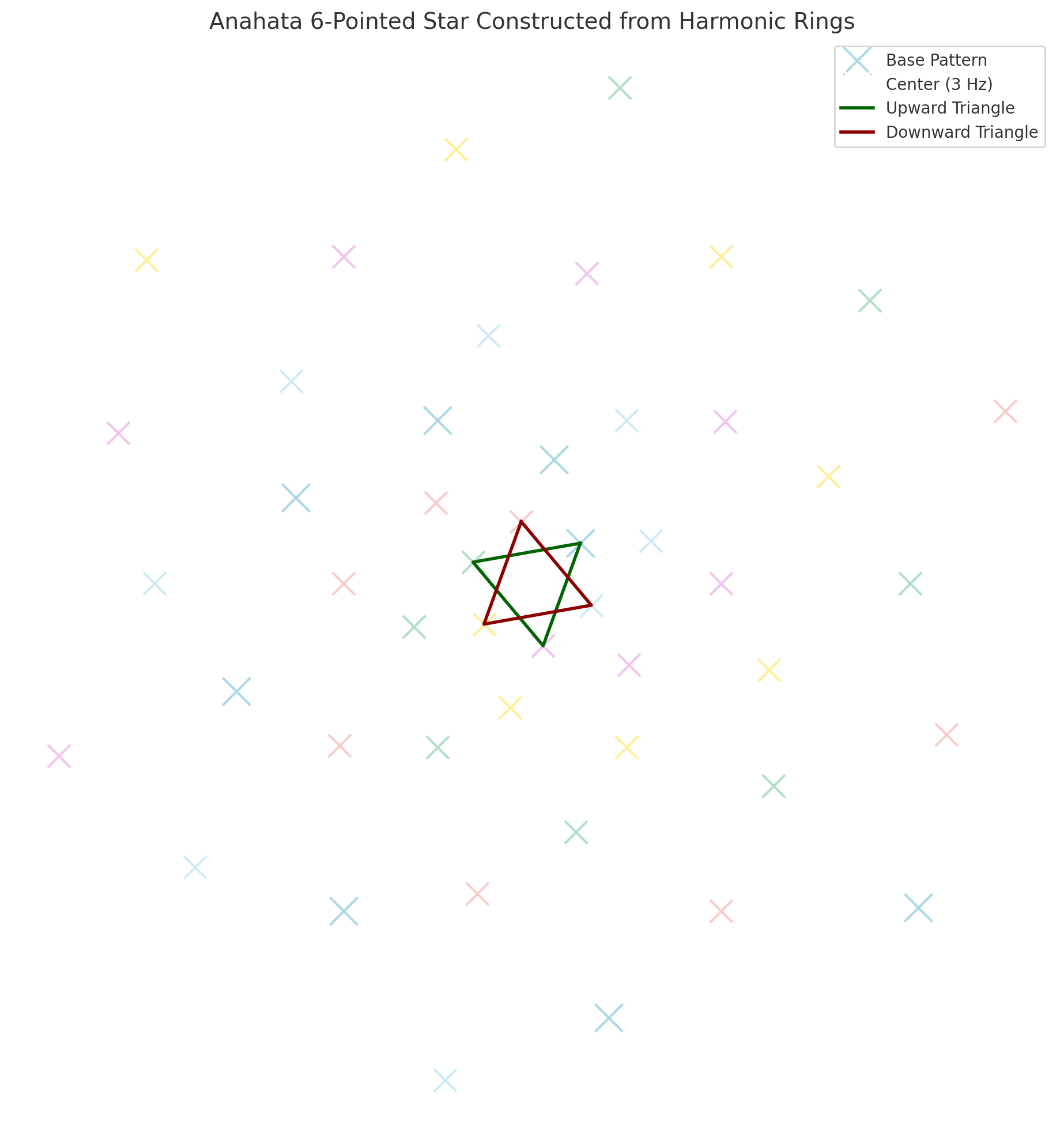
While many know the Anahata as the heart chakra or a symbol in spiritual traditions, fewer have explored its potential as a geometric form generated through frequency. In this article, we explore how simple mathematics, symmetry, and sound can recreate the six-pointed Anahata star using nothing more than harmonic frequency rings and rotational logic. No spiritual belief required.
The Concept of Anahata Frequency Geometry
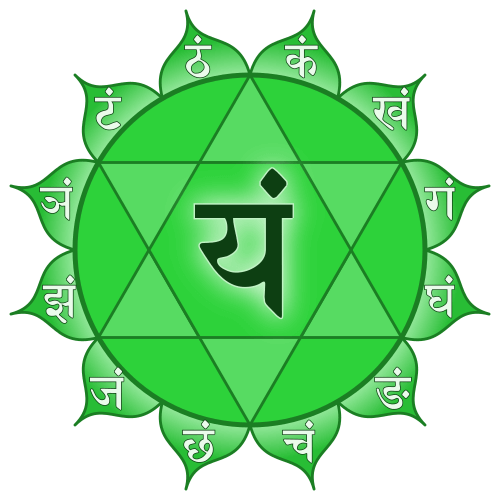
The traditional symbol of Anahata is a six-pointed star, composed of two interlocking triangles. While it’s most often viewed as a symbol of balance or inner harmony, the geometry itself can be recreated using frequency-based logic.
Starting with a fundamental tone—3 Hz—we generate nine concentric rings of frequency using a spacing of ±3 Hz. That gives us frequencies like 3 Hz (center), 0 Hz and 6 Hz (Ring 2), -3 Hz and 9 Hz (Ring 3), and so on. When we plot these points outward in a radial pattern and apply 60° rotations to the entire structure, we discover something unexpected: a perfect six-pointed star.
The Scientific Pattern Behind the Star
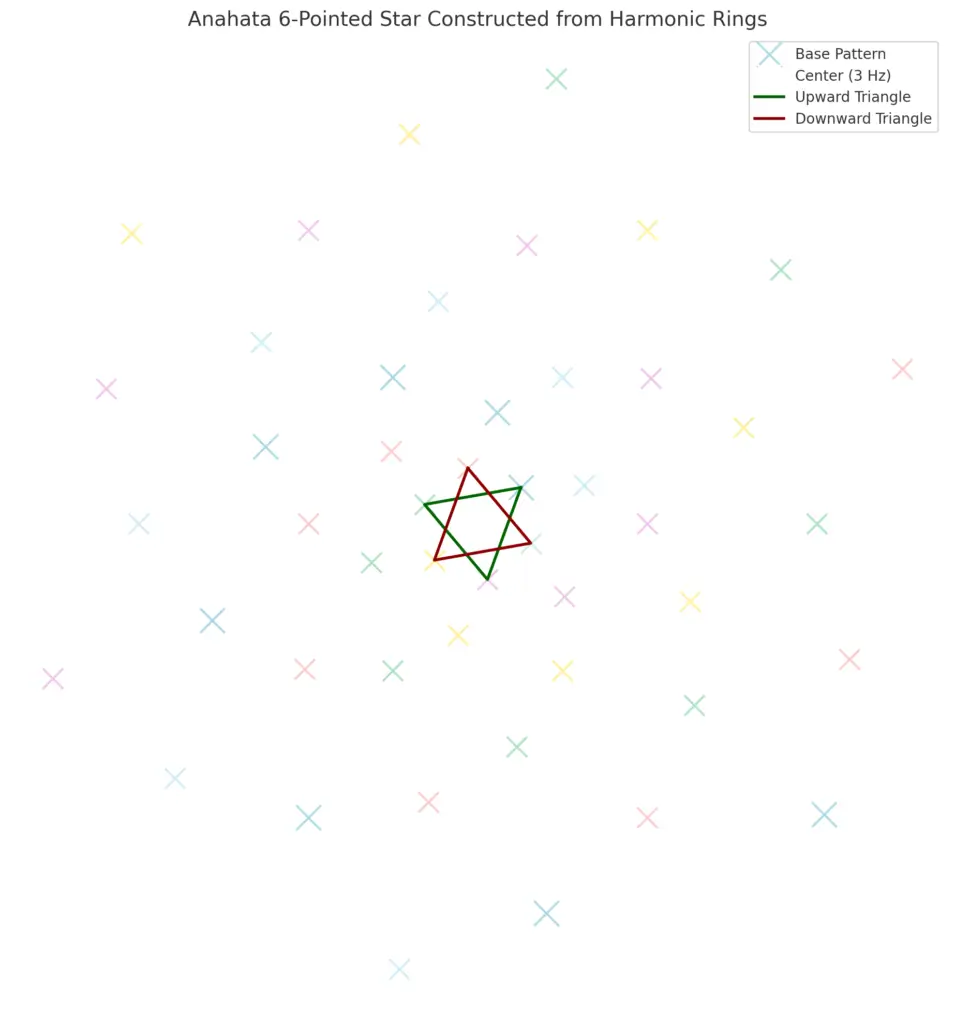
Here’s what we found:
- Uniform Radius Spacing: Each ring is spaced by an exact increment of 1.2 units.
- Rotational Symmetry: Rotating the ring layout by 60° increments forms six distinct arms.
- Triangular Overlay: Two equilateral triangles emerge by connecting alternating rotational peaks.
This layout replicates the Anahata star without symbolism—only math and geometry. No mystical decoding required.
Why 3 Hz?
The choice of 3 Hz isn’t arbitrary. In numerics, 3 is often considered a base pattern of harmony, and in mod-9 digital root systems, it’s part of a stable loop: 3, 6, 9. When using ±3 Hz steps, the entire field resolves back into 3 and 6 repeatedly. In our frequency table, all outer rings (2 through 9) reduce to a digital root of 6, while the center remains at 3.
This means:
- The entire pattern breathes in 3 and 6.
- It exhibits harmonic containment.
- It doesn’t scatter, it spirals and reflects.
Overlaying the Triangles
By taking one set of points and rotating them by 60°, 120°, 180°, 240°, and 300° around the center, we generate overlapping petals. Connecting three alternating points forms an upward triangle; the opposite three form a downward triangle. Together, they create the full six-pointed star at the heart of the structure.
This isn’t symbolic metaphor. It’s the geometry of repetition, symmetry, and resonance.
What This Means Practically
If you’re a sound designer, healer, mathematician, or curious learner, this model invites exploration. It suggests that harmonic principles can create archetypal structures through repetition and symmetry alone. Whether you’re building a tone map or studying sacred geometry from a purely mathematical perspective, this model bridges both.
So, What My Conclusion
The Anahata star isn’t just a spiritual icon. As we’ve shown, it’s a product of well-structured harmonic geometry. By combining frequency rings with rotational mathematics, we can recreate its form without referencing spirituality or belief. Just sound, structure, and elegant design.
Whether you’re looking for resonance or simply enjoy patterns that work, Anahata frequency geometry might just speak your language.
Bonus
Multiples of 3 result in the same outcome, just in a higher harmonic octave. Can you see where this is going?