
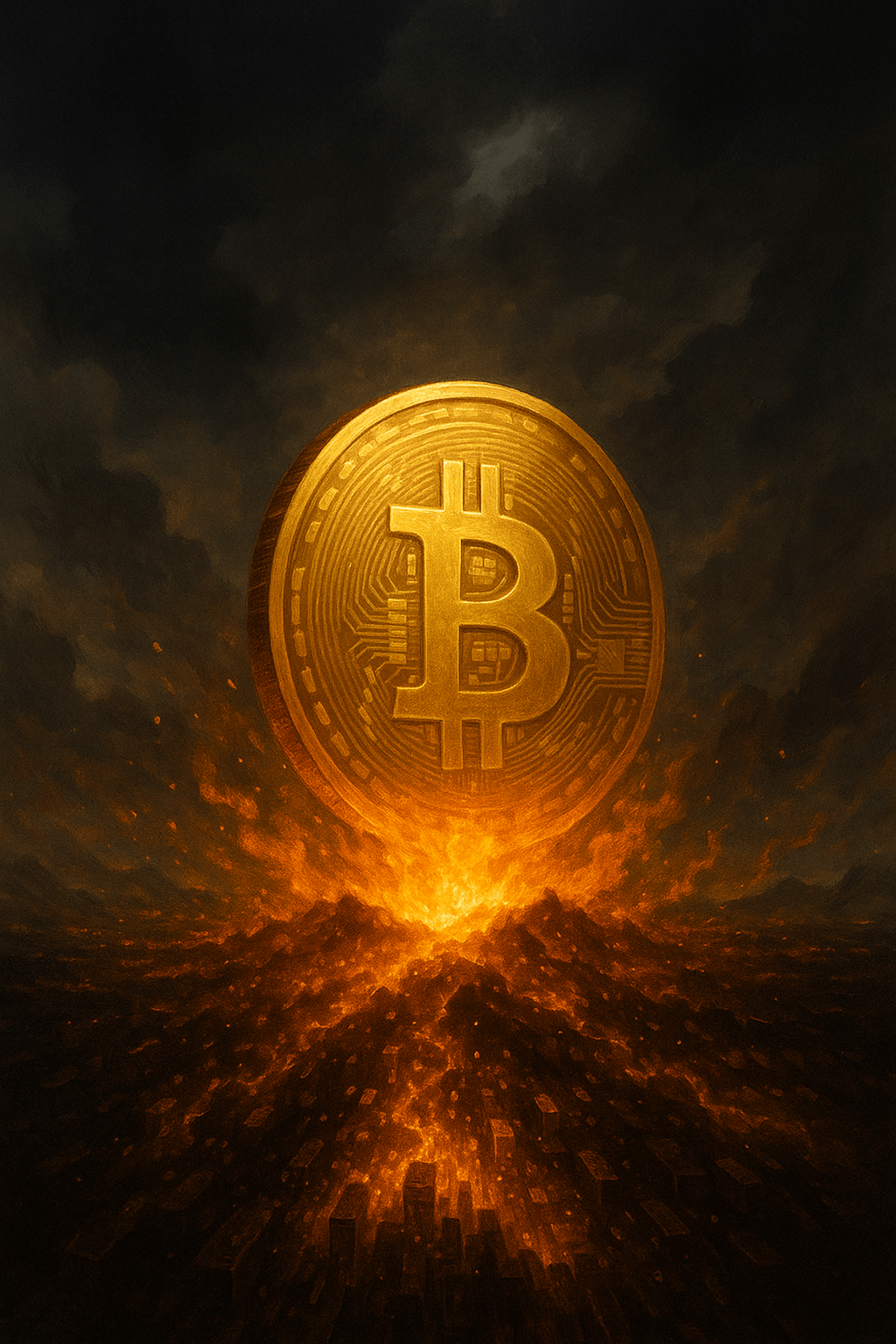
The Birth of an Idea – When Trust Broke Down
Bitcoin origin story – Every revolution starts with a crack in belief.
In 2008, the world watched the walls of its financial temples collapse. Banks failed, trust vanished, and the same governments that preached free markets rushed to save the very institutions that caused the disaster.
It was a global awakening – the moment people realized that money, the foundation of civilization, was built on promises that could be rewritten overnight.
In that vacuum of trust, a spark flickered.
A white paper appeared online – signed by someone, or perhaps a group, using the name Satoshi Nakamoto. It wasn’t just code. It was a manifesto disguised as mathematics.
A declaration that said: “We can rebuild trust – without middlemen, without rulers, without permission.”
The Crisis That Lit the Fuse
When the housing market collapsed, millions lost homes, jobs, and futures – but the banks didn’t lose power. They were bailed out, while ordinary people were told to tighten their belts.
The world’s wealth had become digital smoke, printed and erased at the whim of unseen hands.
And yet, the system survived – not because it was stable, but because people still believed they had no alternative.
Satoshi’s paper, “Bitcoin: A Peer-to-Peer Electronic Cash System,” was a quiet act of defiance. It didn’t shout in protest; it whispered a solution.
It proposed a new form of money – one that didn’t need permission, central banks, or trust in any authority.
In doing so, it redefined rebellion itself: not through anger or protest, but through creation.
The Code That Defied Kings
Bitcoin’s genius wasn’t in its technology – it was in its philosophy.
It merged centuries of cryptography, economics, and game theory into something more powerful than currency: a system of truth.
Where the old world said, “Trust us,” Bitcoin said, “Prove it.”
Every transaction is verified by math, not men; Every rule is transparent; Every participant equal under the code.
It was as if Satoshi had rewritten the Magna Carta for the digital age – a constitution for those who no longer trusted kings, banks, or governments.
And the timing couldn’t have been more poetic.
In the very first block, Satoshi embedded a message:
“The Times 03/Jan/2009 Chancellor on brink of second bailout for banks.”
A quiet signature, a line of text that would echo through history – proof that Bitcoin was born not from greed, but from betrayal.
From Cypherpunks to Satoshi – The Rebellion Behind the Mask
Satoshi didn’t emerge from nowhere.
They stood on the shoulders of giants – the Cypherpunks, a movement of privacy advocates, mathematicians, and hackers who believed freedom in the digital age required encryption.
They saw surveillance growing, governments tightening control, and corporations turning users into products.
To them, code was speech – and cryptography, the language of liberty.
Bitcoin was their prophecy fulfilled – the tool that made their philosophy real.
It wasn’t just a new form of money; it was a weapon against control, wrapped in math and protected by proof.
When Satoshi disappeared, it wasn’t an ending – it was a beginning.
They left behind not a product, but a movement – one that could no longer be stopped because it belonged to everyone.
The First Block – A Declaration of Independence
The “genesis block” wasn’t just data – it was an act of rebellion.
A self-sustaining idea that didn’t ask for permission to exist.
When that first Bitcoin was mined, something shifted in the collective consciousness.
For the first time in history, a system of value existed beyond borders, beyond banks, beyond rulers.
No central bank could inflate it; no government could seize it; no single point of failure could destroy it.
Bitcoin had no headquarters, no CEO, no hierarchy – only consensus.
It was freedom encoded.
And in that moment, humanity’s relationship with money quietly changed forever.
The Rise of a Movement – When Code Became a Cause
Bitcoin’s early years were ridiculed by the mainstream – dismissed as geek fantasy or digital nonsense.
But while the world mocked, a new class of pioneers built in silence.
Developers, miners, idealists – they weren’t chasing profit; they were chasing purpose.
Forums buzzed with philosophy as much as with code. Every update was debated, every change weighed, every idea shared in open view.
It was messy. It was human. And that’s what made it real.
Slowly, people began to understand: this wasn’t about technology – it was about sovereignty.
About reclaiming the power to define value for ourselves.
The fire spread – not through marketing, but through awakening.
The Fire Spreads – The Rebellion Evolves
Today, Bitcoin is no longer just a network – it’s a mirror.
It reflects what humanity values most: freedom, fairness, and truth that cannot be censored.
It’s a rebellion not of violence, but of verification.
Not a war for control, but for consciousness.
And just like all great revolutions, it’s not really about the system it destroys –
It’s about the one it inspires.
Because Bitcoin’s true gift isn’t wealth.
It’s wisdom.
The wisdom that we no longer need to ask for freedom.
We can build it.