
The Truth Behind Negative Hertz in Sound, Math, and Energy
Are Negative Frequencies Real?
If you’ve ever worked with sound, waveforms, or energy models, you might have asked:
Can frequencies be negative?
The short answer is:
Yes in math, no in physical sound.
But like most simple answers… the real story is far more interesting.
Let’s break it down 👇
1. In Physical Sound — ❌ No, Frequencies Can’t Be Negative
In real-world audio, a frequency refers to the number of vibrations per second.
This is measured in Hertz (Hz) — and by definition, Hertz is always positive.
| Example | Frequency (Hz) |
|---|---|
| Low bass note | 40 Hz |
| Middle C | ~261.6 Hz |
| High whistle | ~3,000 Hz |
There’s no such thing as -40 Hz in physical sound.
You can’t make air vibrate backward in time — so from the perspective of audio equipment or the human ear, negative frequencies don’t exist.
2. In Math & Signal Theory — ✅ Yes, Negative Frequencies Exist
Here’s where it gets interesting.
In mathematics and engineering, negative frequencies do exist — and they have real meaning.
They usually represent the direction of rotation in a complex wave.
Imagine a circle.
Spinning clockwise = -1 frequency
Spinning counterclockwise = +1 frequency
In Fourier analysis (used in sound synthesis, radio, and quantum mechanics), every waveform can be broken into spinning waves. These may rotate in different directions, so negative frequencies show up as phase inversions or mirror waves.
🧠 Think of them like:
- Mathematical shadows
- Inverse rotations
- “Ghost frequencies” that complete the symmetry
3. In Energy Models, Spiritual Geometry & Harmonic Theory — ✅ Yes, Symbolically and Structurally
Outside of classical physics, in fields like:
- Sacred geometry
- Harmonic resonance
- Sound healing
- Energy medicine
- Tonal mandalas
…negative frequencies are used intentionally as mirrors or balancing poles.
For example:
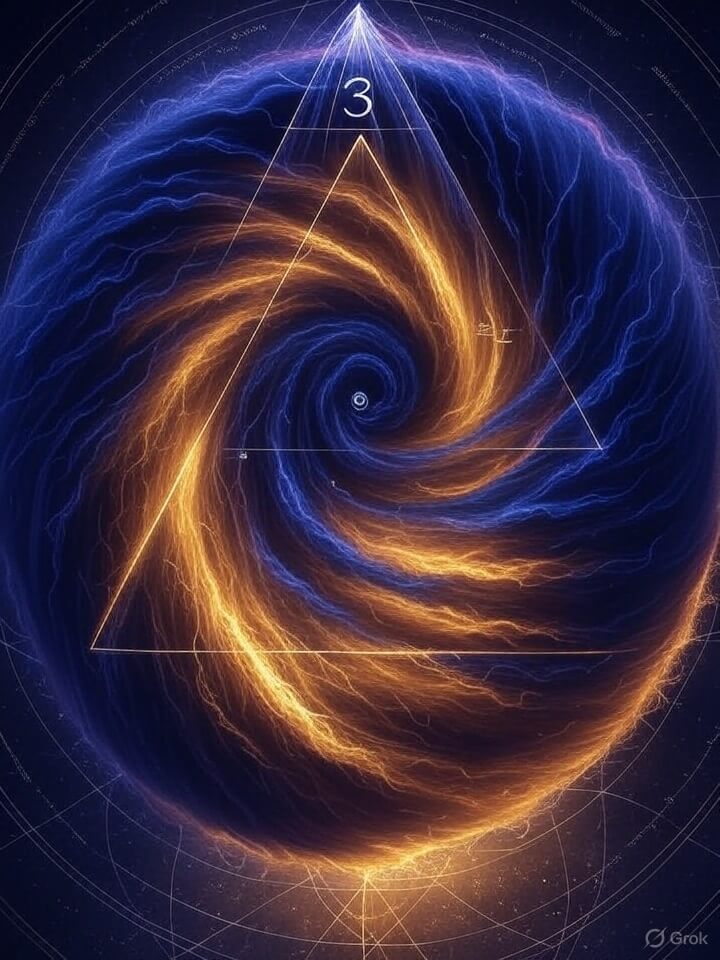
You might pair +111 Hz with -105 Hz, centered on 3 Hz, to form a symmetrical frequency triangle.
This doesn’t mean you’ll hear -105 Hz —
but it symbolizes the inward pull or inverse resonance that mirrors +111 Hz.
So, Can Frequencies Be Negative?
✅ In math and engineering? Yes.
❌ In physical sound or music? No.
✅ In harmonic models and energy structures? Yes, as symbolic or structural tools.
Related Topics to Explore
If this sparked your curiosity, here are more articles and concepts to dive into:
- What Is Phase Inversion in Sound Design?
- Fourier Transform Explained Simply (Khan Academy)
- Sacred Geometry in Frequency Design (Sound Healing Resource)
- Tesla’s 3-6-9 and the Secrets of Vibration
Final Thought
Negative frequencies remind us that sound isn’t just what we hear —
It’s also what holds symmetry in the background.
So next time you build a harmonic structure — consider what’s unseen.
It may be spinning the other way