
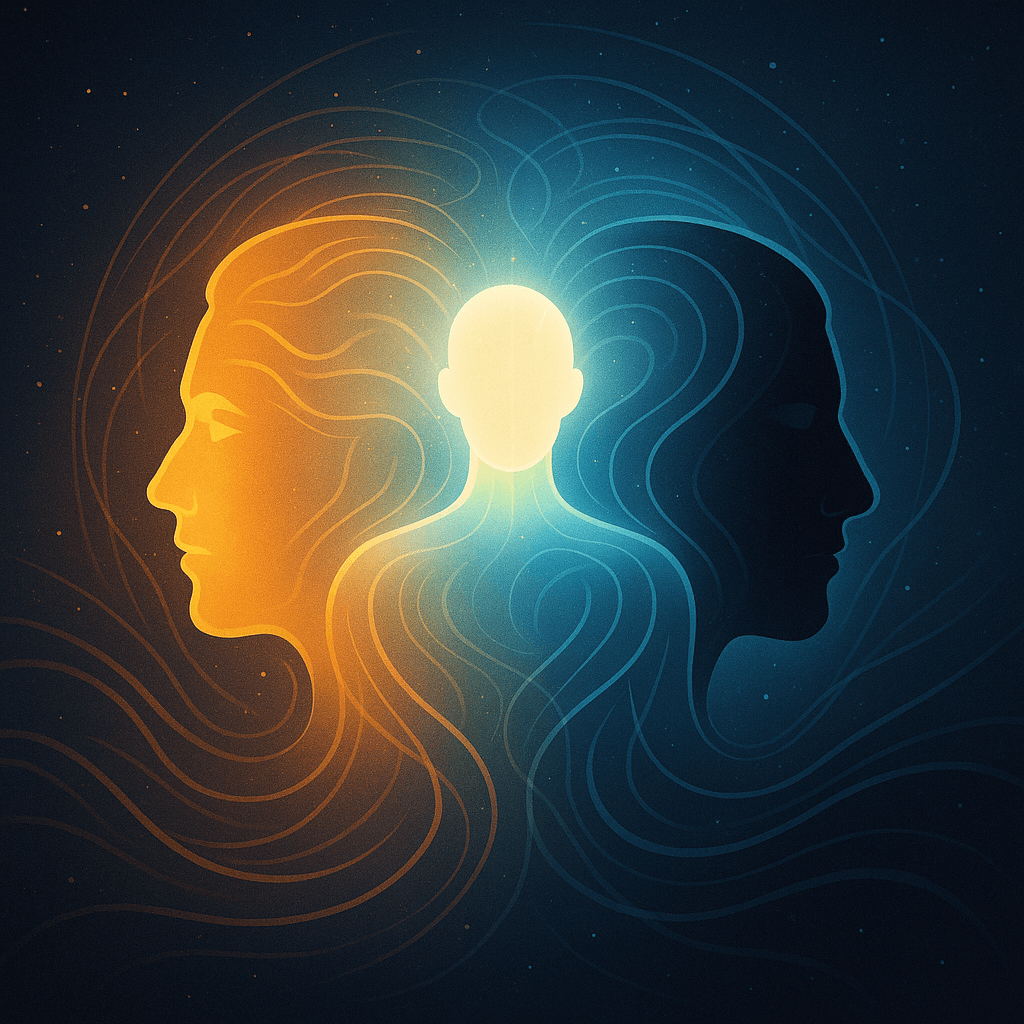
The Two Faces of the Mind
Most people believe their mind is one unified thing, a single voice guiding their choices, thoughts, and emotions. But anyone who’s ever argued with themselves knows that isn’t quite true. Sometimes, we feel like two people sharing the same space: one part calm, logical, and forward-looking… the other emotional, reactive, and sometimes completely unpredictable.
This inner duality isn’t madness; it’s mechanics.
The conscious and subconscious minds are like two halves of a whole, each running its own part of the program. The conscious is the architect, designing blueprints, making plans, and setting intentions. The subconscious is the engineer, carrying out those designs using stored patterns, emotions, and past experiences.
When the two are in sync, life flows effortlessly. Decisions feel natural, intuition sharpens, and emotion becomes a guide instead of a saboteur. But when they fall out of alignment, we get what I call The Jekyll and Hyde Effect, a psychological tug-of-war between what we want and what we feel.
One moment we’re Dr. Jekyll – calm, confident, and creative.
The next, we’re Mr. Hyde – anxious, self-doubting, or impulsive.
Neither side is wrong; both are trying to protect us. The conscious mind protects our goals, while the subconscious protects our safety. But when fear or old programming distorts that safety, it can override even our best intentions, turning potential into paralysis, clarity into confusion, and self-trust into self-sabotage.
This isn’t about controlling the subconscious, though; it’s about understanding how these two aspects of mind communicate, miscommunicate, and ultimately, how they can reunite as one coherent system.
Because in truth, there’s no monster in the mirror, only a misunderstood reflection waiting to be integrated.
The Split – Why the Mind Turns Against Itself
The split doesn’t happen overnight. It forms slowly, almost imperceptibly, as the subconscious starts making adjustments based on experiences it believes will keep us safe. What begins as protection quietly becomes distortion.
At the root of every emotional fracture is a mismatched meaning.
Something painful happens, a breakup, failure, loss, or humiliation, and the subconscious encodes not only the memory, but the emotional frequency that came with it. Later, when the conscious mind tries to revisit that event, it doesn’t just recall facts; it re-experiences the frequency.
This is why a memory that should bring warmth can instead trigger sadness, shame, or regret. The subconscious, doing its job, has linked the event to emotional data that no longer matches the person we’ve become. In effect, it has “overwritten” the emotional code to prevent vulnerability, even at the cost of joy.
Over time, the subconscious begins prioritizing safety over truth. It filters reality through old programs, pushing us toward familiar patterns even when those patterns hurt. This is the mind’s paradox: it would rather keep you alive in fear than risk letting you thrive in uncertainty.
Neuroscience gives us a clue to how this happens. The amygdala, the brain’s emotional alarm system, works closely with the hippocampus, which stores memories. When trauma or chronic stress hits, the amygdala tags those memories with heightened emotional charge. The hippocampus then stores not just the image of the event, but the emotional intensity attached to it. That tag remains active, even years later.
So when a trigger appears, a word, a song, a smell, the subconscious replays not the event itself, but the emotional echo. The conscious mind can’t tell the difference. It reacts as though the threat is still real.
This is where Dr. Jekyll and Mr. Hyde begin their conflict; the conscious self wants to move forward, but the subconscious self keeps steering back into old terrain, mistaking the familiar for the safe.
The result isn’t evil, it’s entrapment.
The mind is caught in a loop, trying to protect itself from a danger that no longer exists.
But here’s the hopeful part:
What the subconscious learned, it can also unlearn.
Once we understand how to rewrite the emotional code, the split begins to heal, and the two minds can finally speak the same language again.
The Override — How the Subconscious Rewrites Emotion
The subconscious doesn’t speak in words; it speaks in associations.
Every experience we have, especially the emotionally charged ones, creates a link between an event, a feeling, and a meaning. When these links are healthy, they act as an internal compass. When they become distorted, they pull us off course.
Think of the subconscious as the emotional database of your life. It doesn’t analyze; it records. If you touch a hot stove, it records pain. If you fall in love and get hurt, it records vulnerability as danger. Later, when you meet someone new, that memory quietly runs in the background, whispering, “Careful… remember what happened last time?”
The problem is that the subconscious doesn’t know when to stop protecting you. It takes “once dangerous” as “always dangerous.” In doing so, it rewrites emotional responses, not because it’s cruel, but because it believes it’s keeping you safe.
Here’s how it works:
- The conscious mind sets an intention: “I want to trust again.”
- The subconscious searches its database: “Trust = Pain. Block it.”
- The result: hesitation, anxiety, or emotional shutdown.
That’s the override in action. The subconscious filters the world through emotional tags from the past, and since it runs faster and deeper than conscious thought, its influence feels automatic.
This explains why so many people know what they want but feel powerless to reach it. The logical mind says, “Go left.” The emotional field says, “Left leads to pain.” The body obeys the emotional command, not the intellectual one.
But here’s the fascinating part:
The subconscious doesn’t differentiate between real experience and deeply felt imagination. That means emotional tags can be rewritten. Through awareness, visualization, and emotional re-association, we can teach the subconscious a new pattern, one where trust equals growth, where love equals expansion, where action equals safety.
This is the essence of emotional alchemy: transforming the energy of an old experience into the frequency of a new one. When the subconscious sees consistent evidence that the new pattern is safe, through felt emotion, not logic, it updates the code.
And that’s the turning point. The same mechanism that once held us back becomes the very key to our transformation.
The Misalignment Loop – Conscious vs. Subconscious Programming
When the conscious and subconscious aren’t aligned, life can feel like driving a car with one foot on the accelerator and the other on the brake. You know where you want to go, but something unseen keeps holding you back. That “something” isn’t weakness or lack of willpower; it’s misalignment between two powerful operating systems.
The conscious mind runs on deliberate thought, intention, reasoning, and goal-setting. It’s like a programmer writing new code. But the subconscious mind runs on emotional memory; it executes whatever pattern has been proven “safe” through repetition. Even if that pattern limits growth, it stays loyal to it, because to the subconscious, safety outweighs happiness every time.
This is how the misalignment loop begins:
- You set a new conscious goal.
- The subconscious checks its stored data.
- If the new goal doesn’t match old programming, it resists.
- That resistance generates emotion – fear, doubt, procrastination.
- The conscious mind interprets that emotion as failure or lack of motivation.
And.. the cycle repeats.
Each loop strengthens the emotional charge of misalignment. The subconscious becomes more convinced that the new path is dangerous, while the conscious mind becomes more frustrated and self-critical. In time, this inner feedback loop becomes an emotional echo chamber; the louder the conscious mind pushes, the stronger the subconscious pulls.
But here’s the crucial insight: the subconscious isn’t fighting you, it’s following its training. Every “no” it sends is a “yes” to survival. Once we shift perspective from “enemy” to “messenger,” the dynamic changes entirely.
The goal isn’t to override the subconscious; it’s to update it.
Repetition, emotion, and sensory feedback are the tools it understands. When we consciously create experiences that feel safe, joyful, and aligned, we show the subconscious that it can release its old defense protocols. The two systems begin syncing, not through force, but through coherence.
This is what transforms “self-sabotage” into self-protection that’s finally been heard, understood, and reprogrammed.
The misalignment loop ends when both minds agree on what “safe” really means.
Rewriting the Code – The Path Back to Integration
Rewriting the emotional code doesn’t happen through force; it happens through trust. The subconscious doesn’t respond to commands; it responds to consistency. It’s like a cautious animal emerging from the forest; it watches, waits, and only moves closer when it senses genuine safety.
The bridge between the conscious and subconscious isn’t thought, it’s feeling.
That’s the secret most people miss. The conscious mind speaks the language of words and plans, but the subconscious speaks the language of emotion and experience. To rewrite the code, we must translate intent into feeling, embodying the new pattern so the subconscious can record it as truth.
Here’s the formula in simple terms:
- Awareness – Catch the old pattern in action without judgment.
- Reframing – Redefine what the emotion means. Fear doesn’t mean “stop”; it can mean “expand carefully.”
- Reassociation – Pair the new emotional meaning with physical or mental imagery that feels good.
- Repetition – Feed that new pattern through experience until it becomes the subconscious default.
When these four steps are practiced with intention and emotional presence, something remarkable happens: the subconscious begins to cooperate. You’ll notice less resistance, smoother flow, and emotions that once felt overwhelming now serve as signals rather than storms.
It’s not about deleting the past; it’s about updating how it lives in your nervous system. The memory remains, but its charge transforms. Pain becomes wisdom. Regret becomes awareness. Fear becomes direction.
And that’s the true nature of integration, when both minds learn to trust one another again. The conscious sets the vision, and the subconscious provides the energy to bring it to life.
When the two align, the inner dialogue quiets. The emotional static clears.
And in that silence, the real “you” emerges, not the fractured self divided by old programming, but the coherent consciousness that’s been there all along.
That’s the point where Jekyll and Hyde shake hands, not as enemies, but as partners in evolution.
Harmony Restored – Becoming the Unified Self
When the conscious and subconscious finally integrate, life doesn’t suddenly become perfect; it becomes coherent.
The noise quiets. The conflict dissolves. Thought and feeling move in rhythm again, like two instruments playing the same song.
Integration isn’t about silencing emotion or overriding logic. It’s about giving both parts of the mind the same sheet of music. The conscious mind provides the melody, the vision, the direction, the higher ideal. The subconscious provides the rhythm, the emotional pulse, the memory of movement, the flow that makes the melody real.
Together, they create harmony, not a static state of bliss, but a dynamic balance that constantly adjusts and refines itself through awareness.
This is where self-regulation becomes self-creation. The unified mind no longer reacts from fear or repetition; it responds from alignment. Challenges still arise, but they no longer define the individual; they refine them.
In neuroscience terms, this harmony looks like coherence between brainwave states. The analytical beta rhythms of the conscious mind begin syncing with the intuitive alpha and theta patterns of the subconscious. Emotion and logic start firing together, producing calm focus, the neurological signature of integration.
In practical terms, this looks like intuition that feels trustworthy, emotions that feel purposeful, and choices that feel natural. Life begins to flow through you instead of happening to you.
You stop chasing outcomes and start shaping them, not by forcing your will, but by allowing the unified field of mind to express itself freely.
The Jekyll and Hyde Effect dissolves when we realize there was never a monster inside us, only unintegrated intelligence, waiting to be brought into harmony.
And once that happens, will, emotion, and awareness no longer pull in different directions.
They become one, moving as a single current in the river of consciousness.
The Return to Wholeness
Every journey through the mind eventually leads back to the same place: unity.
The conscious and subconscious were never meant to compete; they were meant to collaborate. Each brings something vital to the table: reason and intuition, order and emotion, structure and flow. When separated, they create confusion and inner conflict. When reunited, they create coherence, a steady rhythm that guides thought, feeling, and action toward a single aim.
The Jekyll and Hyde Effect isn’t a flaw in human nature; it’s an invitation to evolve. It shows us that consciousness isn’t meant to dominate the subconscious but to partner with it, to update, guide, and harmonize it through awareness and emotion.
This is where the series naturally turns toward the bridge, the space where intention becomes experience, and experience becomes transformation. Understanding this bridge is what allows us to move from theory into practice, to actually feel the change happening within us.
Because integration doesn’t just heal the mind, it frees it.
And in that freedom, the self that once fractured finally remembers it was whole all along.