
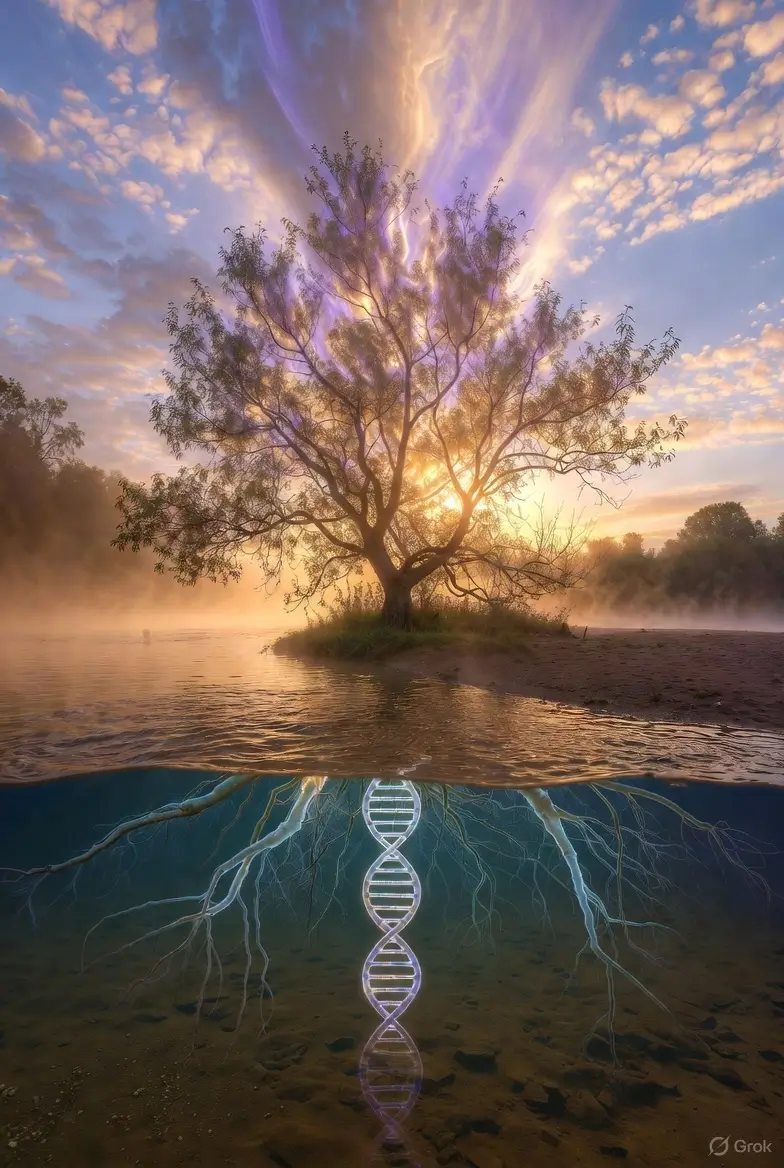
In part one, we explored the foundations, DNA, psychology, and how experience shapes the person we become.
But beneath all those layers, something remains untouched.
A quiet awareness that observes the thoughts, feelings, and stories, yet is not made of them.
That’s where the question deepens:
If the body and the mind are shaped by time and influence, what is the “I” that watches it all?
The Philosopher’s Self
The search for the core self isn’t new; it’s as old as thinking itself.
Socrates said, “Know thyself,” yet never quite defined who that “self” was.
Plato imagined the soul as eternal, temporarily embodied, yet always striving to remember its true home.
Meanwhile, the Stoics saw the self as the rational spark within, the piece of divine reason (logos) that connects all living things.
Later, in the East, philosophy took a gentler turn.
Hinduism described the Atman, the inner essence identical with Brahman, the infinite consciousness of existence itself.
Buddhism challenged even that, teaching Anatta, the “no-self,” the idea that what we call “I” is only a collection of changing experiences, like a flame passed from moment to moment.
Different paths, same mountain:
Each tradition, in its own language, pointed toward something ungraspable, a presence that is but cannot be possessed.
The Spiritual View: The Witness Within
In many mystical teachings, the core self is described as the witness, the silent observer behind all thought.
It’s not the thinker, not the doer, not even the dreamer. It’s the one who sees them all.
Modern mindfulness traditions echo this same realisation.
Thich Nhat Hanh called it “the space of awareness,” where thoughts and feelings come and go like clouds across the sky.
When the clouds pass, the sky doesn’t disappear; it simply remains, vast and unchanged.
So perhaps the core self is not something we find by digging deeper, but something we notice when we stop digging altogether.
It reveals itself in stillness, not search.
Science and the Observer
Interestingly, science is starting to brush against this same mystery from another angle.
Neuroscience can locate where thoughts form, but not where awareness itself resides.
Even the most advanced brain imaging can’t point to a specific “place” for the observer; it just finds activity associated with awareness.
And then there’s the observer effect in quantum physics, the idea that observation itself can influence a system’s behaviour.
It’s as if reality needs consciousness to exist in a certain way, as though the act of seeing shapes what’s seen.
We might not yet understand how or why, but it raises a fascinating possibility:
Maybe consciousness isn’t inside the body. Maybe the body, and everything else, is within consciousness.
The Light and the Prism
If the core self is pure awareness, then what we call “me,” our emotions, personality, and memories, are expressions of that awareness interacting with life.
Imagine white light passing through a prism: the light doesn’t change, but it reveals a spectrum of color depending on how it’s refracted.
In the same way:
- DNA is the shape of the prism, your biological structure.
- Personality and experience are the angles of that prism, the unique way you bend light.
- Consciousness is the light itself, pure, formless, and ever-present.
The colors may shift, dim, or intensify, but the light never ceases to shine.
The Core Self Remembered
When we reconnect with that light, through silence, reflection, or even a moment of awe, something remarkable happens.
The noise of identity fades. The stories fall quiet.
And we remember: we were never the waves; we were always the river itself.
The core self is not a thing to reach, but a truth to remember,
the unchanging awareness that’s been quietly watching your entire story unfold since the moment you opened your eyes to this world.
Reflection
Maybe that’s why children seem so free. They haven’t yet learned to mistake their reflection for their depth.
As we grow, we build layers, necessary ones, but sometimes forget that beneath it all, the same clear awareness still flows.
To know the core self is to come home, not to something new, but to something that’s been patiently waiting beneath every breath.
“The light behind your eyes is the same light that shines through the universe.”
You’ve never been separate from it, only distracted from seeing it.