
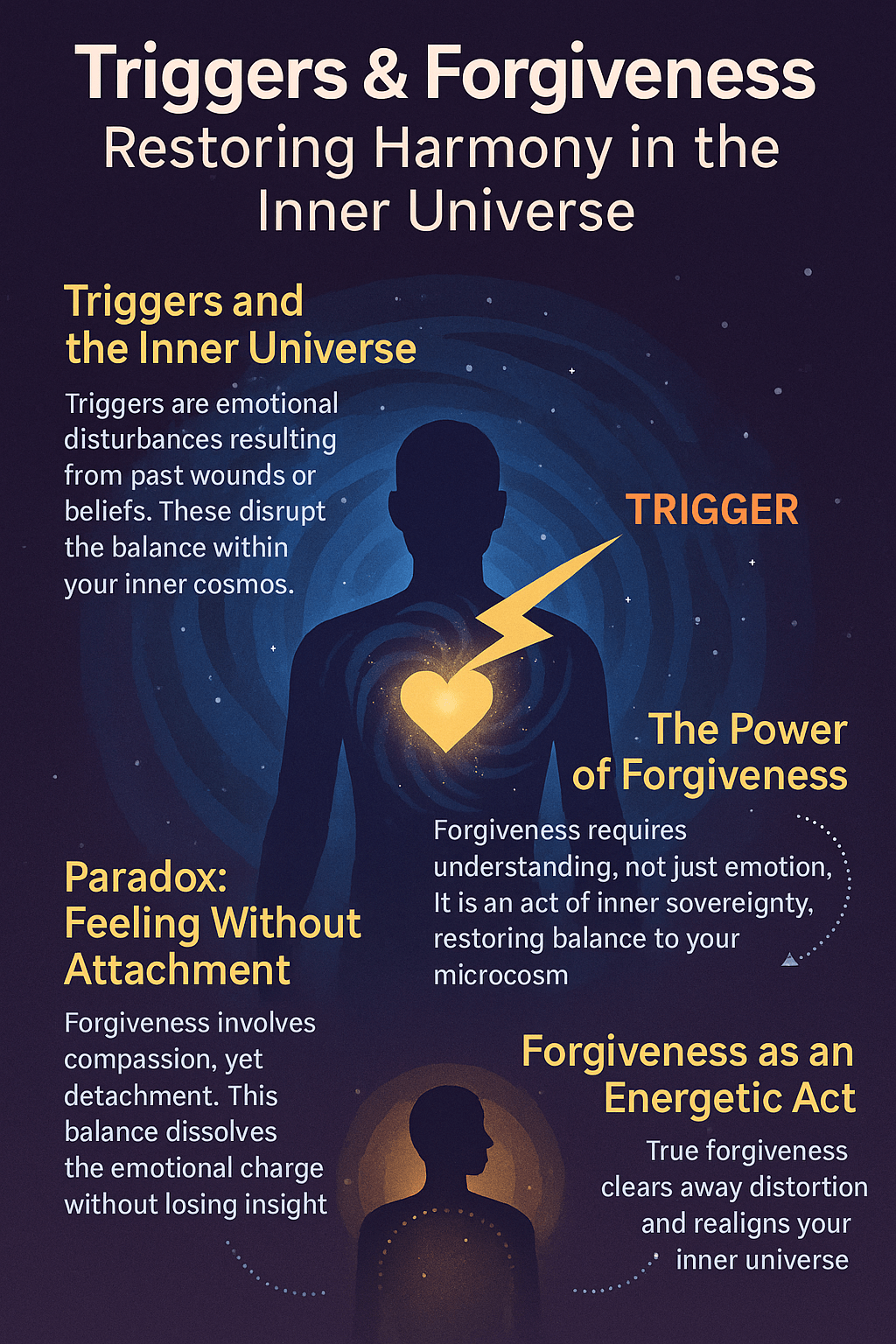
Your inner universe is always responding—to thoughts, actions, memories, and especially emotion. Sometimes, a moment in the outer world hits you hard and unexpectedly: your heart races, your body tightens, your mood shifts. This is a trigger—not a flaw, not a weakness, but a flare from within. And if a trigger is a flare, forgiveness is the balm that cools and restores.
In this philosophy, triggers aren’t threats. They’re signals. And forgiveness isn’t passivity—it’s sovereignty. Let’s explore how these two forces interact, and how conscious forgiveness helps restore balance to your inner universe.
Triggers and the Inner Universe
A trigger acts like a solar flare erupting from your inner sun. It sends shockwaves through your emotional climate, disrupting the harmony between thought, emotion, and intention. The ego, acting as a filter, gets flooded. Your inner planets—your decisions, your health, your balance—start to wobble.
Most triggers stem from unprocessed experience, memory, or belief. Sometimes they’re inherited, sometimes implanted by external pressure or manipulation. When left unaddressed, they repeat, magnify, and distort your internal signals. They alter the trajectory of your thoughts, pollute your intentions, and cloud your perception of the world.
But the trigger isn’t your enemy—it’s a messenger. It says: “Here’s a place that needs your attention. Here’s where you’ve given away control.”
The Power of Forgiveness
Forgiveness, in this light, isn’t about excusing wrongdoing. It’s about releasing yourself from its hold. It’s not saying, “what happened was okay”—it’s saying, “what happened will no longer distort my inner world.”
Forgiveness is a reset of energetic alignment. It restores flow to the microcosm. When you forgive, you reclaim your emotional circuitry from whoever or whatever scrambled it. It’s not about pretending it didn’t hurt. It’s about choosing not to let the hurt define your ongoing story.
And here’s the deeper truth: forgiveness doesn’t always require reconciliation with others. Sometimes it means finally sitting with yourself—with your pain, your misunderstanding, your reaction—and saying, “I see you. I understand. And I’m ready to move forward.”
Paradox: Feeling Without Attachment
To forgive truly, you must feel—but without clinging. This is the paradox:
- You need compassion—but also neutrality.
- You feel the pain—but don’t identify with it.
- You remember—but don’t relive.
This creates a state of knowing. Pure forgiveness happens when the emotional charge dissolves, but the wisdom remains. It’s clarity beyond emotion. Presence beyond pain.
In this space, you don’t suppress or bypass—you integrate. And the ego, no longer clogged with trauma or judgment, begins to mirror the true self.
Forgiveness as an Energetic Act
Think of forgiveness as a cosmic act of healing. Your body softens. Your thoughts realign. The energetic tension releases. The orbit stabilizes.
Forgiveness clears emotional debris from your microcosmic field. It recalibrates intention. It invites light into the dark, honesty into the hidden. When you forgive, you’re not forgetting—you’re transmuting. You’re turning pain into perspective.
And when you do this, your inner universe reflects that change outward. The macrocosm begins to mirror your restored clarity.
Practices for Real Forgiveness
Real forgiveness is work—and it’s worth it. Here are a few ways to practice:
1. The Five Whys
When triggered, ask: “Why did that bother me?” Answer truthfully. Then ask again: “Why is that important to me?” Continue this five times. By the end, you’ll often uncover the core wound or belief. This process helps you find the truth beneath the noise.
2. Breath Awareness
During an emotional spike, pause and breathe. Inhale slowly through the nose, exhale through the mouth. Witness the feeling, but don’t judge it. This allows you to observe without reacting.
3. Energetic Release
Visualize the person or thought you need to forgive. Imagine a cord connecting your hearts. Now picture yourself gently unplugging the cord and letting it dissolve. Whisper: “I release you. I return to myself.”
4. Compassionate Journaling
Write freely about the experience. Start with anger if needed—but always end with understanding. Ask: “What did I learn about myself? What am I ready to release?”
From Reaction to Resolution
In this philosophy, forgiveness is not weakness—it is alchemy. It turns hurt into healing. It transforms chaos into clarity. And it reestablishes you as the conscious creator of your own cosmos.
So the next time you’re triggered, don’t just recoil. Reflect. Don’t rush to move on. Understand.
Because every emotional spike is an opportunity to cleanse, clarify, and elevate your inner world. And when your microcosm is aligned, the outer world can’t help but shift with it.
You are not the sum of your wounds. You are the space that holds the power to heal them.