
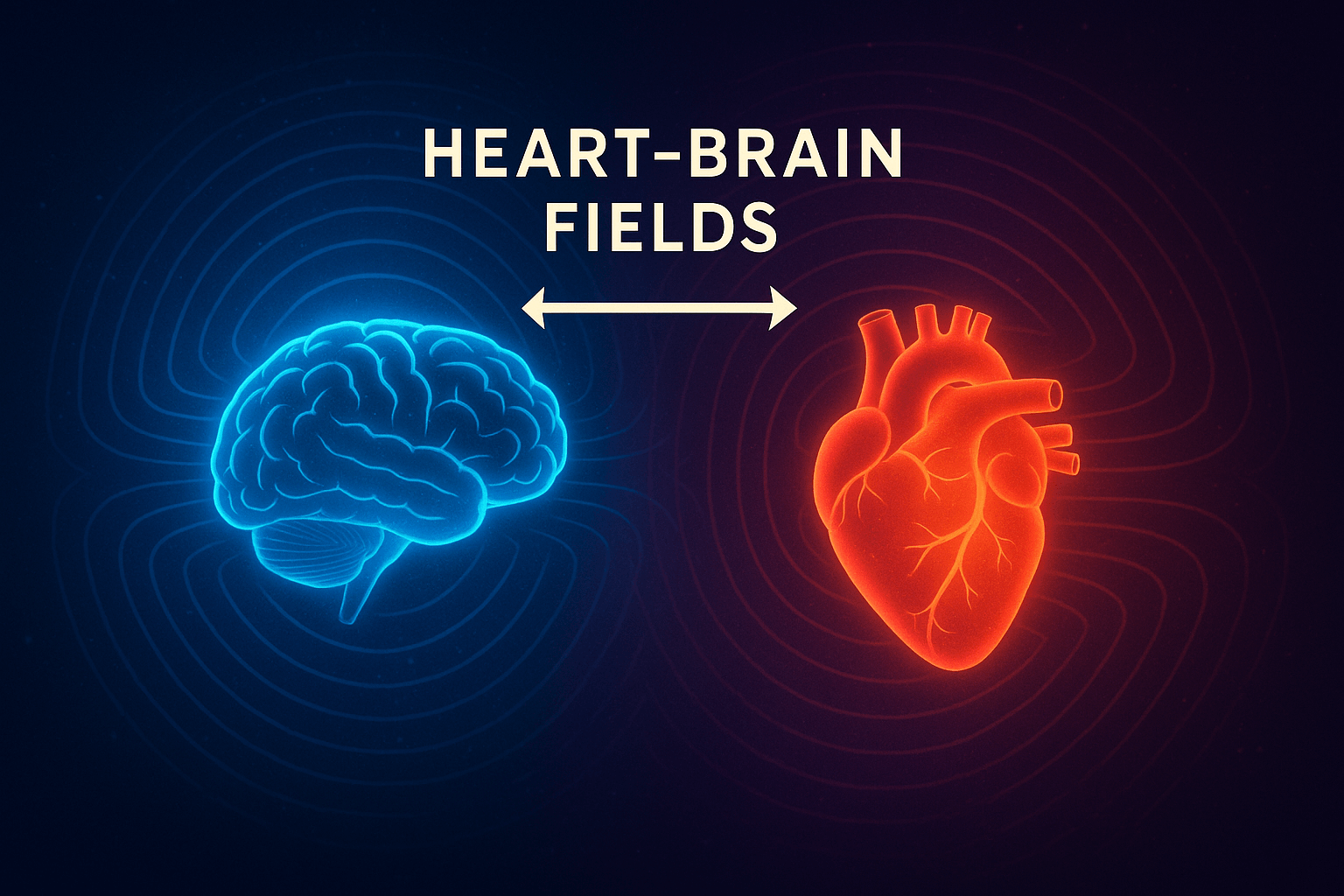
More Than Just a Metaphor
We often say “follow your heart” or “trust your gut,” but science is showing that these aren’t just poetic ideas. The heart is more than a pump — it communicates with the brain through electrical signals, biochemical messengers, and its own electromagnetic field. When the heart and brain are in sync, we experience what researchers call coherence — a harmonious state that can transform our health, mood, and relationships.
The Science Behind Heart-Brain Fields
The Heart’s Electromagnetic Field
- The heart produces the strongest electromagnetic field in the human body — about 100 times stronger electrically and up to 5,000 times stronger magnetically than the brain.
- This field extends several feet outside the body, measurable by instruments like magnetocardiograms (MCG). Note. They never tested beyond several feet.
Heart-Brain Communication Pathways
- Neurological Signals – The vagus nerve carries more signals from the heart to the brain than vice versa.
- Hormonal Messages – The heart releases hormones such as atrial natriuretic peptide (ANP), which influences brain activity.
- Biophysical Pulsations – Pressure waves from the heartbeat can synchronize brain rhythms.
- Electromagnetic Interactions – The heart’s EM field may act as a carrier wave for emotional and intuitive information.
Coherence: The Harmony Between Heart and Brain
Heart-brain coherence happens when your heart rhythm is smooth and consistent, and your brain waves match this pattern. In this state:
- Stress hormones like cortisol decrease.
- DHEA (a rejuvenating hormone) increases.
- Emotional stability improves.
- Intuition and decision-making become clearer.
Example: If you’re anxious, your heart rhythm becomes erratic. This “incoherence” sends stress signals to your brain, amplifying the anxiety. But when you shift into gratitude or compassion, your heart rhythm smooths out, sending calming signals that the brain mirrors.
How Heart-Brain Fields Influence Others
Because the heart’s field extends beyond the body, it’s thought to influence people nearby:
- Emotional contagion: Your emotional state can be picked up by others through subtle energetic cues.
- Group coherence: Teams or families in a shared coherent state often experience better collaboration and empathy.
- Interpersonal resonance: Close relationships may naturally sync heart rhythms.
Practical Ways to Align Your Heart and Brain
- Heart-Focused Breathing
- Slow inhale for 5 seconds, slow exhale for 5 seconds.
- Focus on the area around your heart.
- Shift to a Positive Emotion
- Recall a moment of gratitude, love, or appreciation.
- Hold the feeling, not just the thought.
- Practice Daily
- Even 2–3 minutes, several times a day, can retrain your nervous system.
- Use Biofeedback Devices
- Tools like HeartMath’s Inner Balance can track your coherence in real-time.
Why This Matters for Health and Society
On an individual level, coherence improves immune function, sleep quality, and emotional resilience. On a collective level, coherent groups can create more compassionate and solutions-focused communities — something our world urgently needs.
Final Thought
Your heart and brain aren’t separate operators — they’re partners in shaping your reality. By learning to sync them, you’re not just improving your own life; you’re sending a ripple of coherence into the shared human field.