
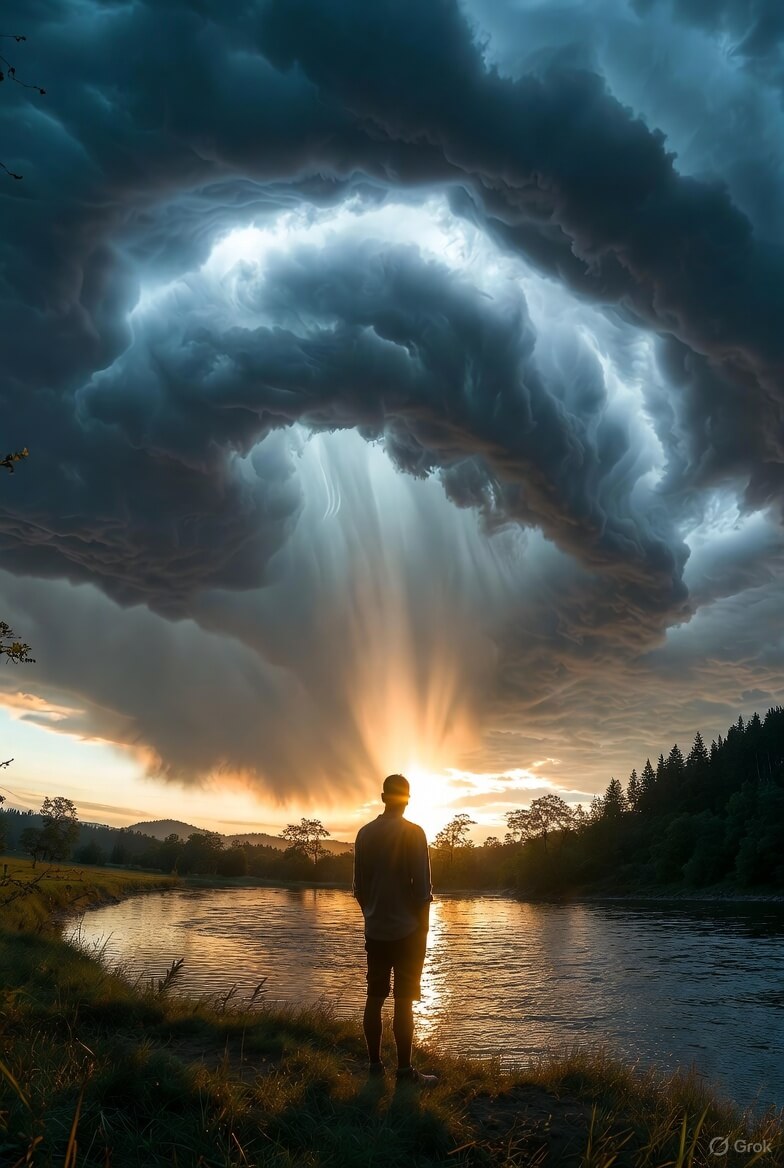
The Moment Before the Storm
You feel it long before it has a name.
A tightening somewhere beneath the ribs…
a heat that doesn’t rise all at once,
but gathers slowly, like a storm rehearsing its first rumble.
It starts as a flicker –
a spark behind the chest bone,
a subtle shift in the rhythm of your breath.
Nothing dramatic.
Just enough for you to think,
Something is changing.
The air feels different.
The world narrows a little.
That invisible line inside you –
the one between “alright” and “not alright” –
begins to tremble.
You know this place.
We all do.
It’s that moment just before the river turns rough,
while the surface is still pretending to be calm.
And here you are, noticing it.
Not flinching away.
Just observing the first ripple.
There’s no judgment here, my friend.
No weight.
No expectation.
Just an invitation to slow your breathing…
and let yourself feel the exact shape of this moment
without trying to change it.
Because this –
right here, before the wave breaks –
is where the real work begins.
Before the fire.
Before the outburst.
Before the world shrinks to a single point of fury.
This is the doorway.
The place where awareness wakes up
and says softly,
“I see you.”
And strangely…
the second you acknowledge it,
the storm eases just a little.
Not because it’s gone,
but because you’re no longer standing in the dark.
You’re watching the river now.
And the river is watching you.
Is Rage Only Destruction?
So let’s pause here,
right at the edge of that inner tremor –
not to brace against it,
but to ask a question most of us never think to ask.
What is rage, really?
Not the version you were warned about.
Not the shame-soaked caricature.
Not the “you need to calm down” lecture
spoken by someone who never bothered to look beneath the surface.
No – the real thing.
That heat that rises so fast it startles you.
That tightening in the throat.
That pressure behind the eyes.
That sudden surge of energy that feels too big
for the body meant to contain it.
Is it simply destruction?
A force that ruins,
breaks,
lashes out,
burns through trust and patience
until only regret is left to sweep up the ashes?
Or…
Is there something else inside it?
Something older.
Something deeper.
Something that doesn’t quite fit the stories you were told.
Because if you look closely –
and I mean really look –
rage doesn’t begin as hatred.
It never starts as malice.
It begins as something far more human:
A boundary crossed.
A truth ignored.
A need unheard.
A wound pressed too many times.
A fear that has run out of language.
Rage is what rises
when the softer parts of you feel cornered
and see no other way to be seen.
And so we return to the question again,
but slower this time:
Is rage really just destruction…
or is it a misunderstood signal
from the deepest part of you
calling for attention?
You can feel the edges of the question changing you already –
opening space,
loosening the grip,
making room for possibility.
We don’t need an answer yet.
Just the willingness to explore.
Because somewhere beneath the fire,
something is waiting to be understood.
The Fire and the River Beneath It
There are always two stories inside rage.
One you can see…
and one that moves quietly beneath the surface.
Let’s look at both –
not to judge,
but to understand the full shape of what’s happening inside you.
SIDE A – The Fire (The Conscious Mind’s Explanation)
Science has a very clear way of describing rage,
and it’s surprisingly simple once you hear it spoken plainly.
Your amygdala –
the alarm system of the brain –
detects a threat.
Not always a physical one.
Sometimes a tone of voice.
A memory.
A boundary crossed.
A familiar pattern of being dismissed.
In less than a heartbeat,
the body surges into fight mode:
- Adrenaline floods the bloodstream
- Muscles tense
- Vision narrows
- Breath shortens
- The prefrontal cortex – the rational part – dims its lights
It’s not that you choose rage.
It’s that your body chooses survival.
From the outside, it looks like you’re “overreacting.”
But on the inside?
Your nervous system is screaming:
“I am not safe.”
In this version of the story,
rage is nothing mystical –
just a cascade of biological signals
trying (desperately) to protect you.
But science, my friendy…
science only explains half the truth.
And the half it misses
is the part that hurts.
SIDE B – The River Beneath the Fire (The Subconscious Truth)
Because under the biology,
under the adrenaline,
under the tightening jaw and the clenched fists,
there is a much quieter story…
One the conscious mind often can’t hear.
Rage is the voice of a deeper part of you –
a part that once learned
it had to shout
to be taken seriously.
A part that remembers
every time you were silenced,
dismissed,
overlooked,
criticised,
or left unprotected.
A part that has carried
too many swallowed words
and too many unseen wounds.
And when that part finally speaks –
it doesn’t whisper.
It roars.
Not because it wants to destroy,
but because it has run out of other ways to exist.
If you sit with it long enough,
you’ll notice something strange:
The fire you feared
doesn’t feel like hatred at all.
It feels like hurt trying to protect itself.
It feels like a river
pushing against a dam
that was never meant to hold it.
It feels like something inside you saying:
“Please…
don’t ignore me again.”
Two layers.
Two truths.
One reaction.
And together they create the storm you call rage.
Where These Two Stories Meet
Here’s the surprising thing:
The biology and the emotion
aren’t fighting each other.
They are cooperating.
Your body and your subconscious
are both trying, in their own way,
to keep you safe.
Rage isn’t a malfunction.
It’s communication.
A warning.
A boundary.
A memory.
A message.
But like all powerful forces,
if misunderstood,
it becomes destructive.
If understood…
it becomes transformative.
And this is where we begin the turning –
where the fire starts revealing the energy beneath it,
where the river begins to find its true direction.
When Rage Reveals Its Depth
There’s a moment –
sometimes only a breath long –
when something inside you pauses.
Not because the rage is gone,
but because a crack of light has opened in the middle of it.
It’s subtle.
Almost easy to miss.
But if you’re here,
reading these words slowly enough to feel them…
you’re already in that moment now.
This is where the fire starts to separate
from the meaning you attached to it.
Where the instinct
and the interpretation
stop being the same thing.
Where you finally get to see
what rage has been carrying for you all this time.
Not hatred.
Not violence.
Not darkness.
But energy.
Raw, unfiltered, unrefined energy.
A surge of life-force
too big for the old container
you were taught to squeeze yourself into.
And here’s the part nobody tells you:
Rage doesn’t rise because you’re out of control.
Rage rises because a part of you
is trying to regain control
of something that once left you powerless.
That’s the truth beneath the fire.
Not destruction –
protection.
Not aggression –
a boundary crying to be recognised.
Not madness –
the body trying desperately to finish a story
that was interrupted years ago.
This is where modern psychology and ancient wisdom
quietly shake hands.
Somatic therapy calls it thwarted fight energy –
a survival impulse that never got to complete its arc.
Philosophy gives us the contrast:
Aristotle suggesting that anger, in the right amount,
can be a moral force…
while the Stoics warn us that anger blinds us
before it guides us.
Both are true.
Because anger without awareness is a wildfire.
But anger with awareness
is a forge.
And now the turning becomes clear:
Rage is not asking you to explode.
It’s asking you to listen.
To the boundary that was crossed.
To the hurt that was ignored.
To the part of you that was silenced.
To the strength inside you that has never been fully met.
This is the moment the storm changes shape –
when you realise you are not fighting the river…
you are learning to read its currents.
You feel it now, don’t you?
The softening.
The shift from fear to curiosity.
The fire becoming something more familiar,
almost recognisable.
Not an enemy.
A signal.
A messenger.
A memory.
A force.
This is the turning point.
Where rage begins its transformation
into something you can use…
something that can nourish,
guide,
protect,
and restore.
And from here,
we can begin building the bridge
from fire to fuel.
From Fire to Fuel
Something begins to change here –
quietly, almost imperceptibly –
as if the storm inside you has taken a single long breath
and remembered its own name.
The fire that once felt wild
starts to reveal its contours.
Its edges soften.
Its heat becomes less threatening,
more familiar,
like stepping close to a flame you once feared
only to discover it was meant to warm you.
And you realise:
Rage is not asking to be extinguished.
It is asking to be understood.
Because beneath the sharpness,
beneath the pressure,
beneath the surge of intensity,
there is something else –
something older than the rage itself.
Life-force.
The purest kind.
Unfiltered.
Untamed.
Unclaimed.
The kind of energy that creation is made from.
The kind of energy that moves rivers,
builds mountains,
erupts through the earth
when it refuses to be held any longer.
And suddenly the inner landscape shifts:
Rage stops appearing as a threat
and starts appearing as potential.
Like a river that once flooded
only because no one ever carved a channel for it to flow through.
Like fire that only becomes destructive
when it has no hearth to rest inside.
Like a voice that becomes loud
only because it spent too many years being unheard.
This is the bridge.
The turning from reaction → into awareness → into direction.
Here is the truth you were never told:
Rage is not the opposite of healing.
Rage is the raw material that healing is made from.
Because that force inside you?
The intensity you thought meant something was wrong with you?
It is the same energy that, when guided, becomes:
- courage
- clarity
- boundaries
- truth
- creativity
- transformation
- nourishment
Think of a river again –
when it breaks its banks, it destroys.
But when it’s channelled,
when it’s understood,
when its flow is given purpose…
…it feeds entire fields.
It sustains life.
It becomes the heart of a whole ecosystem.
Your rage works the same way.
When you meet it with fear, it floods.
When you meet it with shame, it erupts.
But when you meet it with awareness –
slowly, gently, the way you’re doing right now –
the current begins to move differently.
It stops thrashing
and begins to guide.
It stops shouting
and begins to speak.
It stops hurting
and begins to nourish.
And this is where the integration begins –
not by suppressing the rage,
not by denying it,
not by pretending to be “above” it,
but by recognising that inside the fire
is the very energy you’ve been trying to access
in every moment you’ve ever wanted to heal,
grow,
or change.
This is the place where the path forward opens.
Where the fire becomes fuel.
Where the river becomes direction.
Where the storm becomes strength.
Where the body and mind step into partnership again.
And from here,
the alchemy can begin.
The Four-Stage Alchemy of Rage
Up until now, we’ve been walking around the edges of the fire –
watching it, understanding it,
feeling how it rises,
how it moves,
how it speaks.
But transformation doesn’t happen by theory alone.
There comes a moment –
a quiet one –
when understanding must become action.
Not explosive action…
not suppression…
but guidance.
Rage, after all, is energy.
And energy becomes whatever you shape it into.
So here – gently, clearly, and step by step –
is the alchemy.
The shift from fire → into fuel → into nourishment.
⊙ Stage 1 – Awareness: Naming the Fire Softens the Flames
Most people meet rage with two reactions:
Fight it (“I shouldn’t feel this”)
or
Become it (“I can’t stop myself”).
Both reactions feed the fire.
But something remarkable happens when you do neither –
when you simply recognise the moment it rises.
Just a quiet, honest sentence:
“I am in rage.”
No judgment.
No guilt.
No apology.
That single act of awareness
switches the brain
from the amygdala (reactive)
toward the prefrontal cortex (regulated).
It doesn’t solve everything,
but it gives you one thing rage tries to take away:
choice.
Awareness is not control –
it’s space.
And space is where transformation begins.
🜁 Stage 2 – Containment: Holding the Riverbanks
Rage is overwhelming because the energy has nowhere to go.
It builds, presses, pushes,
and the body interprets it as danger.
Containment isn’t suppression.
It’s giving the energy a boundary
so it doesn’t explode outward.
Think of it like cupping your hands around rushing water
without trying to stop it.
Simple containment tools:
- Step out of the room
- Lower your shoulders intentionally
- Lengthen your exhales
- Feel your feet on the ground
- Say nothing until the heat drops
This is the nervous system equivalent
of placing gentle walls along a river
so it doesn’t flood the village.
Containment gives you safety
without cutting off the flow.
🜃 Stage 3 – Movement: Letting the Body Finish What It Started
Here’s the truth nobody tells you:
Rage is physical first, emotional second.
If you don’t give the body a way to release the fight energy,
the mind will spiral trying to make sense of it –
and the fire intensifies.
Healthy release isn’t violence.
It’s completion.
A few ways to let the body discharge safely:
- Push your hands against a wall with full strength
- Press your feet into the floor and exhale sharply
- Shake your arms and legs for 30 seconds
- Do fast, controlled squats
- Scream into a pillow or towel
- Clench a towel hard, then release
This is the stage trauma researchers mean
when they talk about “thwarted fight energy.”
You’re not “calming down.”
You’re letting the nervous system finish a story
it never got to complete.
After this release,
the mind naturally softens
because the body is no longer in battle-mode.
The river flows freely again.
◯ Stage 4 – Redirection: Turning Energy Into Nourishment
This is the moment everything changes.
Once the body has released the storm,
what remains is pure energy –
no longer chaotic,
no longer overwhelming,
but potent, warm, alive.
This is where you choose what happens next.
You decide where that energy goes.
It can become:
- A boundary you finally set
- A conversation you have with clarity, not heat
- A workout that moves you forward
- Creativity that was waiting for fuel
- A project you’ve been avoiding
- A truth you’ve been holding back
- A shift in your life that requires courage
- A moment of deep honesty with yourself
When rage is redirected,
it becomes momentum.
Direction.
Resolve.
Strength.
Creation.
Healing.
You start to understand why some people,
after years of working on themselves,
say something like:
“I don’t get less angry now.
I just use the energy differently.”
This is the nourishment.
The transformation.
The inner river finally flowing
where it was always meant to go.
And when these four stages work together…
You don’t suppress the fire.
You don’t fear it.
You don’t let it burn you.
You don’t let it burn others.
You guide it.
You shape it.
You learn from it.
You grow with it.
And rage – the thing you were taught to hate –
becomes one of your deepest sources of strength.
A guardian.
A compass.
A truth-teller.
A current that carries you home.
Working With the Energy in Real Time
By now, you’ve seen the full shape of rage –
the biology,
the emotion,
the history,
the energy,
the potential.
But when the moment hits –
when the spark catches
and the heat rises fast –
you need something simple.
Something you can reach for
even when the mind is narrowing
and the body is tightening like a fist.
Here are the tools that bring you back into yourself
without shutting the energy down.
1. Rage Body-Mapping: Where Does the Fire Live?
Before you try to change anything,
simply notice where rage sits in your body.
Close your eyes for a second
and ask quietly:
Where is the heat?
Where is the tightness?
Where is the pressure?
Where is the movement?
Most people feel it in:
- the chest
- the throat
- the jaw
- the fists
- the stomach
Just identifying the location
takes the reaction out of “everywhere”
and puts it into one clear space.
Your subconscious recognises this as safety.
2. The 90-Second Rule: Let the Wave Pass
This one surprises people:
The chemical surge of anger
(last breath of the fight-or-flight response)
only lasts 90 seconds
unless you feed it with thought.
So here’s the practice:
When you feel the rush hit, say silently:
“Just 90 seconds. I can breathe through this.”
You don’t have to fix anything in that window.
Just breathe.
Just don’t add mental gasoline to the flame.
When the wave passes,
your choices become clearer.
3. The Wall Push: Completing the Fight Response
Rage is a body event.
So give the body what it’s asking for:
a controlled, safe outlet for strength.
Place both hands on a wall,
lean your weight into it,
and push with full strength
for 5–10 seconds.
Breathe out sharply as you push.
This releases the “fight” impulse
without harming you or anyone else.
When you stop pushing,
you’ll feel a sudden drop in intensity –
like the energy has somewhere to go
for the first time in years.
4. Cold Water Reset: Calming the Nervous System Quickly
If the heat becomes overwhelming,
run cold water over:
- your wrists
- your hands
- or splash some on your face
This resets the vagus nerve
and slows the fight response.
It’s a physical “interrupt”
that brings you back into your body
without suppressing the emotion.
5. Movement as Medicine: Let the Energy Move
When the body is charged,
staying still intensifies the feeling.
A few rapid, grounding actions:
- 20 fast steps
- 10–15 squats
- shaking your arms and legs for 20–30 seconds
- punching a pillow
- stomping your feet deliberately
This is not “exercise.”
It’s completion.
You’re letting the nervous system finish the arc
it started when the threat was detected.
6. A Simple Boundary Sentence: Clarity Without Flame
Once the storm shifts into fuel,
you often need to speak.
Here’s a single sentence
that carries strength without aggression:
“I need a moment. I’ll talk when I’m grounded.”
It protects you
and signals to others
that you’re choosing responsibility.
Later, when clarity returns,
use this:
“When X happened, it made me feel Y.
What I need going forward is Z.”
Calm.
Direct.
Honest.
Clear.
Your power lands without burning.
7. The One-Line Journal Prompt: The Message Behind the Fire
After the heat has softened,
grab a note app or paper
and answer this:
“What was the real message behind the rage?”
Not the story.
Not the blame.
Not the surface anger.
The message.
Maybe:
- “I felt ignored.”
- “My boundary wasn’t respected.”
- “I felt powerless.”
- “That reminded me of something old.”
- “I needed support.”
This is where rage whispers truth
instead of shouting pain.
What These Tools Do Together
They don’t eliminate rage.
They unpack it.
They turn chaos into clarity.
Intensity into groundedness.
Reaction into direction.
Fire into fuel.
And the more you use them,
the more something incredible happens:
Rage stops feeling like something that happens to you,
and starts feeling like something that moves through you
with purpose.
A current you can work with,
not a storm you have to fear.
Returning to the Core Self
And now…
after walking through the fire,
after feeling the river rise and settle,
after learning the shape of your own strength –
you arrive here.
In the quiet.
In the space beyond the storm.
Feel this moment for a second.
Let your shoulders loosen.
Let your breath deepen.
Let your chest soften from the inside out.
Because this –
this gentle return –
is the part most people never reach.
Not because they can’t…
but because they were never shown the way back.
You’ve met your rage today
not as an enemy,
not as a flaw,
not as a monster to keep chained,
but as a force that has always belonged to you.
A force that once rose to protect you
when nothing else could.
A force that carried pain
because you didn’t yet have the words.
A force that held boundaries
before you learned how to speak them.
A force that guarded the younger you
when all you had was instinct and hope.
And now, for the first time,
you’re meeting that force
with awareness instead of fear.
The fire inside you doesn’t burn so sharply anymore.
The river doesn’t thrash.
It moves with direction,
with clarity,
with purpose.
You can feel the difference –
the way the heat settles into warmth,
the way the pressure turns into presence,
the way the old storm finds a new rhythm.
And in this stillness,
a truth rises that was always yours:
You were never broken for feeling deeply.
You were only waiting to learn how to guide your own power.
Rage was never trying to hurt you.
It was trying to be heard.
Trying to protect you.
Trying to finish old stories
so you could finally write new ones.
You stand here now
not as someone who “got rid of their anger,”
but as someone who reclaimed their energy.
The fire is in your hands.
The river flows with you, not against you.
The storm is no longer something you fear –
it’s something you understand.
And with that understanding
comes something rare:
Peace that doesn’t require you to be small.
Strength that doesn’t require you to be harsh.
Clarity that doesn’t require you to be cold.
Power that doesn’t require you to hurt yourself or anyone else.
Just presence.
Just direction.
Just you –
returned to the core.
You close this moment gently,
feeling the last traces of heat settle
like embers warming a quiet room.
You’re here.
You’re grounded.
You’re whole.
And the river within you –
steady, strong, alive –
carries you forward.
Where the Journey Flows From Here
If you’ve made it this far,
you’re already carrying a different energy inside you.
A quieter strength.
A deeper clarity.
A sense that something old within you
has finally been met
instead of feared.
But the journey doesn’t end here –
because rage was only one of the rivers
running beneath your life.
There are other currents waiting:
- the one that rises when your boundaries are crossed
- the one that softens when you finally feel seen
- the one that pulls you toward healing
- the one that carries the younger parts of you forward
- the one that reconnects you to who you were before the world had its say
If you feel called to continue,
here are a few paths that naturally follow the work you’ve done today:
1. Healing Anger in Relationships
Understanding how to express truth
without losing connection.
How to keep your core
without burning the bridge.
How to turn conflict into clarity
instead of collapse.
2. Working With the Inner Child
Meeting the part of you that rage was protecting.
Listening to the voice that never got to speak.
Learning to soothe the younger you
instead of fighting the echoes of their fear.
3. The Nervous System & Trauma Response
Understanding the body’s patterns.
Recognising triggers before they rise.
Learning tools that bring regulation,
safety,
and groundedness
where chaos once lived.
4. Conscious Boundaries
Transforming the energy of “too much”
into the clarity of
“I know what I need.”
Discovering the difference between walls and boundaries.
Strengthening the part of you that stands tall
without hardening your heart.
5. Nourishing Energy as a Daily Practice
How to channel intensity into:
- creativity
- physical strength
- personal change
- emotional awareness
- spiritual growth
Not as a reaction,
but as a way of living.
A Final Thought… A Gentle One
You’re not meant to master all of this at once.
You’re not meant to rush.
You’re not meant to “fix” yourself.
You’re meant to keep following the river –
one bend,
one breath,
one insight at a time.
And as you do,
you’ll notice something subtle but profound:
The same energy that once overwhelmed you
begins to nourish you.
Strengthen you.
Guide you.
This is the real alchemy.
This is the deeper work.
This is the path home.
Whenever you’re ready,
the next step will meet you where you stand.
FAQ: Rage, Healing & Transformation
Can Rage Be Selfish?
Yes: Rage can become selfish when it’s left unchecked. Not because you intend harm, but because when rage takes over, your awareness narrows so sharply that you stop seeing the consequences of your actions.
In that state, you can hurt yourself, hurt the people you love, or damage something important – not out of cruelty, but because the survival part of your brain has drowned out everything else.
Think of it like this:
If someone hasn’t learned what rage really is, they might believe their reaction is justified. They might think they’re protecting themselves when they’re actually acting from instinct, not clarity.
In that moment, rage isn’t wise. Rage isn’t noble. Rage isn’t truth.
It’s just raw, unprocessed energy
trying to escape the body.
That’s why stepping back is essential:
- not to suppress yourself
- not to deny your feelings
- but to prevent the fire from burning where you never intended it to
When you take that step back – when you breathe, contain, and give yourself space – rage transforms from something reactive into something protective, clear, and grounded.
Without that pause, rage can be selfish simply because your pain fills the entire room and leaves no space for the perspective of others.
With awareness, rage becomes wisdom,
strength,
a boundary,
a truth.
Without awareness, rage becomes reaction,
impulse, and sometimes (accidentally)
harm.
You aren’t bad for feeling rage. But learning to guide it is what keeps you safe and keeps the people you love safe, too.
1. Is rage always unhealthy?
No. Rage is a survival response. It becomes unhealthy only when unmanaged or misunderstood.
2. Can rage really be transformed into healing energy?
Yes, when the physical energy is released and redirected, it becomes clarity, strength, and grounded action.
3. What’s the difference between anger and rage?
Anger is frustration or irritation. Rage is a full-body survival response triggered by perceived threat or old wounds.
4. How can I calm rage quickly?
Use physical tools: wall push, shaking, cold water, grounding breath. Don’t try to “think” your way out, release first.
5. Is rage connected to trauma?
Very often. Rage can be a sign of old boundaries that were violated or wounds that were never acknowledged.
6. Can rage harm relationships?
Yes; but once you understand it and learn to work with it, it can actually improve communication and honesty.
7. Can someone heal rage permanently?
You can heal the triggers, strengthen the nervous system, and transform the energy, but rage itself becomes a tool, not a problem.
8. Why do I feel guilty after rage episodes?
Because you weren’t taught what rage really is. Guilt fades when understanding grows.
Note on Seeking Support
If reading this stirred something deeper in you (if your rage feels overwhelming), unpredictable, or tied to pain you haven’t faced yet (you don’t have to do this alone).
There are people who work with this every day: therapists, trauma specialists, somatic practitioners, and professionals trained to help you move through intense emotions safely and without judgment.
Reaching out isn’t weakness. It’s wisdom. It’s strength. It’s choosing the path that protects you and the people around you.
And sometimes, the bravest thing you can do is let someone walk that first part of the journey with you.