
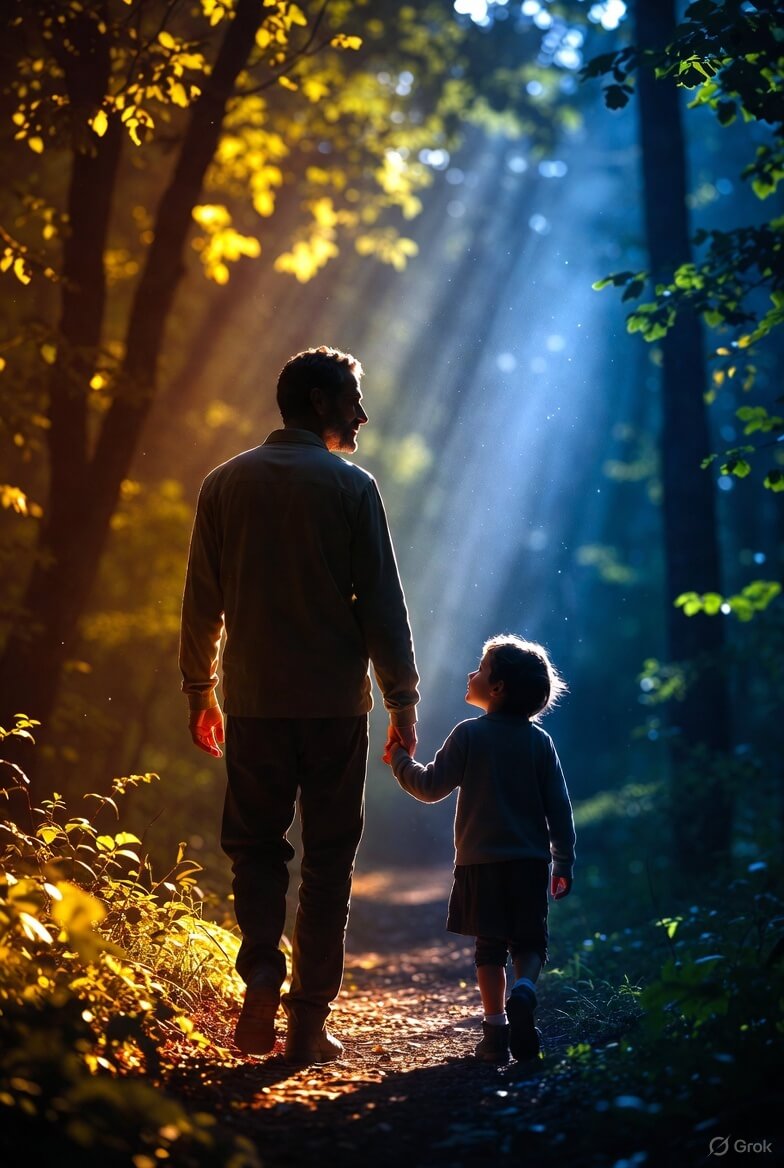
The Split Within
Somewhere between the first scraped knee and the first hard lesson of consequence, a quiet shift occurs.
We stop seeing the world for what it is and start seeing it for what we’ve been told it is.
It’s subtle, a layer at a time, until the once-bright voice of curiosity becomes an echo beneath the noise of “should,” “must,” and “ought to.”
The child within us doesn’t disappear. It simply hides, waiting for permission to play again.
But the world teaches us to value logic over wonder, order over chaos, control over trust.
And so we grow, wiser perhaps, but often narrower in vision.
Yet if we look closely, adulthood isn’t the enemy. It’s simply a mask that forgot the face beneath it.
To reconnect with the core self, we don’t reject adulthood; we remember what we carried before we built its walls.
The Child Side – Pure Awareness
A child doesn’t think about joy; they are joy.
Their awareness is immediate, alive, sensory, unfiltered.
They don’t question whether they’re worthy of love or if their dreams make sense. They live in direct resonance with life itself.
This state of pure awareness is more than innocence; it’s a natural alignment with now.
It’s what spiritual teachers call presence, what mystics call light, and what psychologists glimpse when they study flow.
Children teach through being. They remind us that perception precedes judgment and that truth is often found in laughter, not logic.
There’s science behind this, too. Studies in neuroplasticity and play show that curiosity literally reshapes the brain,
opening new pathways of learning and creativity.
Ancient wisdom knew this long before:
“Unless you become as little children, you shall not enter the kingdom of heaven.” – A reminder not of religion, but of resonance.
When we reconnect with this part of ourselves, we begin to see again, not through conditioned eyes, but through eyes of wonder.
And that vision has power. It melts cynicism, softens the hardened, and rewires the pathways between heart and mind.
But wonder alone can scatter us into dreams without grounding.
That’s where the adult returns, not as a suppressor, but as a guide.
The Child and the Adult: Remembering the Wonder (Part 2)
The Adult Side – Constructed Awareness
As we grow, the spontaneous current of childhood meets the structure of the world.
Rules appear. Consequences arrive. The open field of imagination gains fences of reason.
And for a time, this is necessary, for without form, creation cannot hold its shape.
The adult self learns to pause before reacting, to measure before moving.
It’s the builder, the planner, the strategist, the part that turns dreams into form and emotion into understanding.
It’s the mind that asks why, how, and what next, questions that transform chaos into clarity.
But reason, when left unbalanced, begins to overgovern the inner landscape.
What began as guidance becomes control.
Where the child once trusted, the adult now analyzes.
Where the child once played, the adult now plans.
We begin to live through memory and anticipation rather than presence.
In psychology, this is called over-regulation, the cost of too much control.
In philosophy, it’s the birth of duality, when being splits into thinker and thought, observer and observed.
The adult, in its wisdom, builds walls to stay safe from pain.
But it forgets that those walls keep out joy, too.
And so, wholeness requires that the adult not abandon the child… but learn to listen to its laughter again.
The Balance – Becoming the Whole
To live as both is an art.
It is to walk between wonder and wisdom, laughter and logic, the dream and the deed.
This balance isn’t achieved by rejecting one side for the other; it’s remembering that both speak from the same core self.
The child gives life its meaning; the adult gives life its direction.
When they work together, you live in flow, feeling and knowing at once.
Ancient wisdoms reflected this same truth:
- In Taoism, yin (soft, yielding, playful) and yang (firm, structured, directed) dance within every moment, the eternal movement between being and doing.
- In Hermetic philosophy, mind is both the creator and the creation, mirroring the dual motion of inner and outer worlds.
- Modern psychology echoes it through integration: the reunion of the rational and emotional brain; a harmony that restores clarity, empathy, and creativity.
To be whole, then, is not to become someone new,
but to remember what you were before the world told you who to be.
Seeing Through Clear Eyes Again
When the child and adult unite, perception clears.
Life no longer feels like something to survive or control; it becomes something to dance with.
You can laugh at chaos, learn from stillness, and walk through pain without losing your wonder.
That’s the quiet secret of wholeness:
To grow up is not to grow away.
It’s to circle back, wiser, softer, stronger, and remember who you were all along.
Reflection – A Moment Between Heartbeats
Take a moment to pause, not to think, but to feel.
Breathe in the part of you that once saw magic in raindrops and stars.
Breathe out the part of you that learned to navigate the world with care and reason.
Both are you.
Both are needed.
And between them is the quiet pulse of your core self, steady, timeless, free.
Ask yourself:
- When was the last time I allowed wonder to lead?
- When was the last time I trusted my own wisdom to guide?
- How might my life feel if these two moved together, like breath, in and out, play and peace?
Close your eyes and listen for that still space in between.
That’s where the child and the adult meet.
That’s where you begin again.