
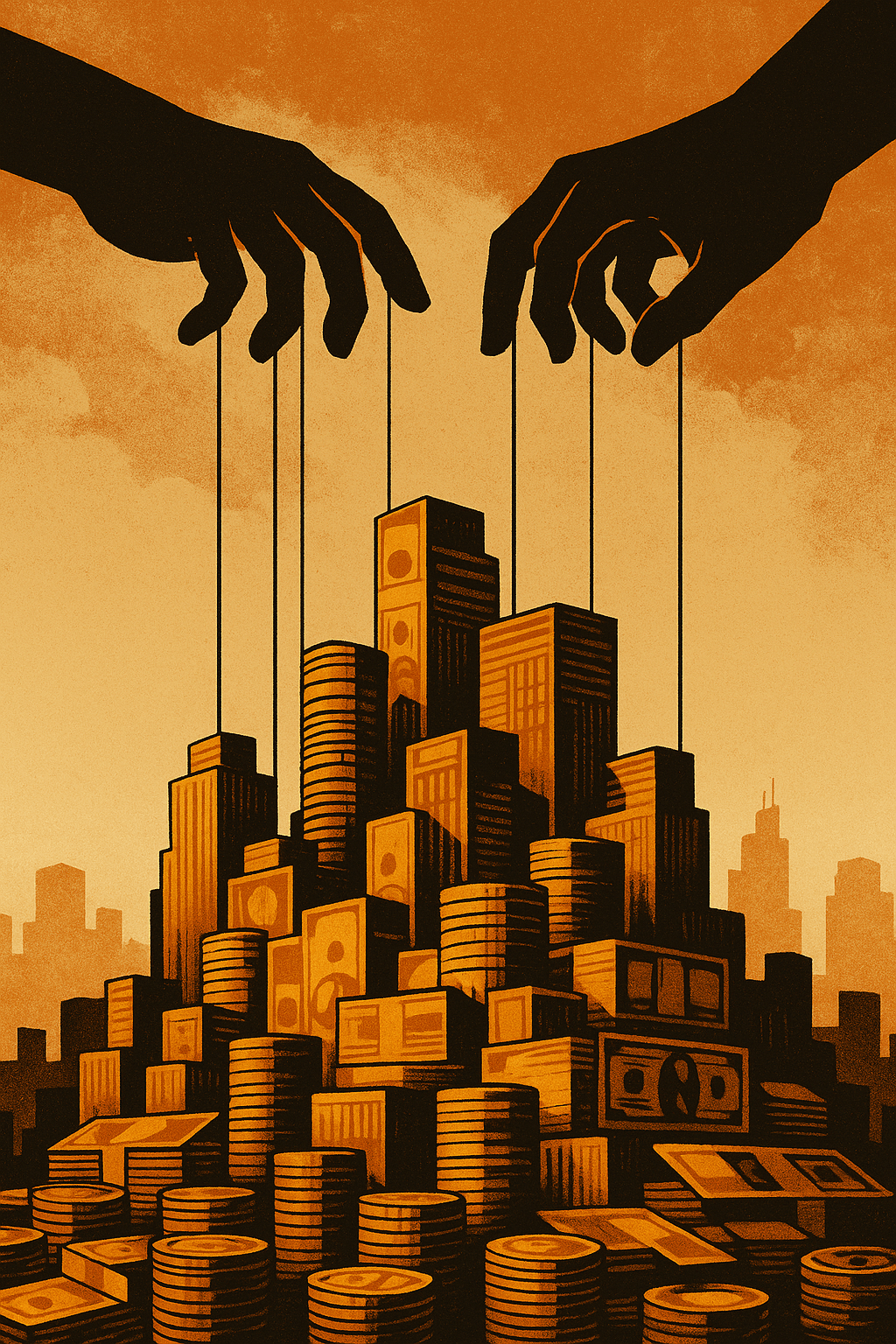
Control by Design – How Money Became a System of Influence
If money is the language of civilization, then control is the grammar that shapes every sentence.
From the moment coins replaced barter, there’s been someone – a ruler, a temple, a state – standing behind the mint. And whoever controls the mint, controls the meaning of value itself.
At first, that control was simple. Kings and Queens stamped their faces on coins to prove legitimacy. The metal had real weight, and the symbol told you who guaranteed it. But as time went on, the symbol began to matter more than the substance. The promise became the power.
By the time paper money appeared, value had already drifted from reality into belief. Banks and governments started creating money not from gold, but from confidence – and confidence can be shaped.
That’s where the architecture of control quietly took root.
When you can influence what people believe is valuable, you no longer need to rule them by force. You rule them through expectation, fear, and dependency – all hidden inside the system they rely on every day.
That’s the genius of modern control: it doesn’t need chains. It just needs consent.
The Mechanics of Obedience – How Debt, Policy, and Inflation Keep People Bound
Control doesn’t always look like control.
It often looks like “stability,” “progress,” or “economic growth.” But behind those comforting words sit three of the most effective tools of modern obedience: debt, policy, and inflation.
Let’s start with debt – the invisible leash.
Every nation on Earth runs on it. Governments borrow money to function, businesses borrow to expand, and citizens borrow to survive. But here’s the twist – debt doesn’t just fuel the system; it defines it.
If everyone paid off their debts tomorrow, the system would collapse. Why? Because most of the world’s money is debt. Every dollar, euro, or pound begins life as a loan – created out of thin air, backed by a promise to repay with interest.
That’s not finance. That’s dependency in disguise.
Then comes policy – the illusion of choice.
Through laws, taxes, and monetary policy, governments can decide who thrives and who struggles. Raise interest rates, and small businesses fall. Lower them, and billionaires grow richer. These aren’t accidents; they’re levers. And the public is taught to call them “economic adjustments.”
Finally, there’s inflation – the slow, quiet thief.
It’s the mechanism that drains the value of savings without ever taking a coin from your hand. You don’t notice it day-to-day, but over decades, it ensures that what you earn never quite catches up to what you owe.
Together, these three forces create a perfect cycle of dependence.
Debt keeps you chasing, policy keeps you guessing, and inflation keeps you moving – just fast enough to stay trapped.
And the best part for those in charge?
You’ll call it “normal life.”
The Illusion of Prosperity – When Growth Becomes the Goal
If there’s one word that can silence almost any critic, it’s “growth.”
Every politician promises it. Every headline celebrates it.
But very few ever stop to ask – growth of what, exactly?
In modern economics, growth has become a religion. Nations are judged by GDP (Gross domestic product), companies by quarterly profits, and individuals by how much they earn, own, or consume. On the surface, it all looks positive – progress, innovation, abundance.
But underneath, growth has a shadow side.
When an economy must constantly expand to survive, it becomes addicted to consumption. More production, more borrowing, more resource use – all to feed a system that can never stand still.
That’s not prosperity. That’s treadmill economics.
Here’s the uncomfortable truth: most “growth” today isn’t about improving human life – it’s about maintaining the illusion of success.
When central banks print more money, stock markets rise, and governments point to charts as proof of a healthy economy. But that “wealth” is digital smoke – numbers inflating in systems that reward speculation over substance.
Meanwhile, real people feel the opposite.
They work harder, save less, and quietly wonder why everything keeps getting more expensive while their freedom shrinks.
It’s not a failure of capitalism – it’s a feature of control.
Because if people believe that growth equals safety, they’ll defend the very system that keeps them struggling.
That’s the beauty – and tragedy – of the illusion.
The Power Pyramid – Who Really Benefits
If you could draw the global financial system, it wouldn’t look like a network – it would look like a pyramid.
At the base are billions of everyday people trading time for money, trying to save, invest, and get ahead. Above them sit corporations and institutions that use that labor to generate wealth. Above them again – banks, investment firms, and governments – managing the flow of that wealth through policies, markets, and debt.
But at the very top, you find something different.
You find the issuers – those who can create money itself.
They don’t earn it, they generate it.
Central banks and a small circle of financial institutions hold the keys to creation. When they “inject liquidity” or “expand the balance sheet,” they’re not finding money – they’re inventing it.
And with every digital keystroke, the ownership of the world subtly shifts upward.
This isn’t conspiracy. It’s design.
A structure built over centuries to consolidate influence while maintaining the illusion of equality.
The result? A society that looks free but functions like a managed ecosystem.
The many produce, the few distribute, and the invisible hand at the top writes the rules.
Even democracy struggles under this weight – because political promises mean little when every decision must serve the debt.
And who owns the debt? The same institutions that issue the money.
It’s a closed loop. A self-feeding hierarchy where control flows downward and wealth flows up.
The genius of it all is that it doesn’t require force.
It just requires belief – that this is the only way the world can work.
Breaking the Loop – Why Decentralization Matters
Every system of control depends on one thing – centralization.
When a few hold the power to decide, approve, or deny, everyone else lives by permission.
That’s why decentralization is so powerful – it doesn’t attack the pyramid; it removes the need for it.
Think of it like this:
In a centralized world, you trust banks to hold your money, companies to protect your data, and governments to manage your future.
But in a decentralized world, trust shifts from institutions to math, code, and community.
That’s what blockchain really is – not a buzzword, but a framework for trust without hierarchy.
It takes the invisible architecture of control and replaces it with transparency, consensus, and participation.
No more black boxes. No more “too big to fail.”
Instead, we get a network that’s open by design – where every participant can verify, where truth can’t be rewritten, and where ownership finally returns to the individual.
Of course, that kind of freedom is messy.
It demands responsibility. It means no one’s coming to fix your mistakes or bail you out when things go wrong.
But that’s the point – real freedom isn’t given, it’s earned.
Decentralization isn’t just a technical revolution.
It’s a psychological one.
It asks people to stop waiting for someone else to fix the world – and start building systems that make the old ones irrelevant.
Because the best way to break control… is to make it obsolete.
The Human Element – Reclaiming Trust in Each Other
For all the technology in the world, freedom will never come from machines.
It comes from people – from trust, cooperation, and the simple belief that we can do better.
That’s the piece most systems forget.
Centralized power doesn’t just control money – it controls trust.
We’re taught to trust brands, banks, and politicians more than our neighbors, to rely on systems rather than relationships.
And over time, that disconnection becomes normal.
But blockchain, at its core, is about bringing trust back to the human level.
It doesn’t remove trust – it redistributes it.
It says, “You don’t have to believe in me, you just have to believe in the math – and in the idea that truth should belong to everyone.”
When people begin to operate with that mindset, something changes.
Communities stop competing and start cooperating.
Transparency replaces suspicion.
And the value of honesty begins to outweigh the value of manipulation.
That’s why decentralization isn’t really about computers – it’s about consciousness.
Because when you give people both the tools and the responsibility to manage their own lives, something ancient wakes up inside them:
that sense of shared destiny, the same spark that built tribes, villages, and civilizations before money ever existed.
Technology may build the framework –
but humanity fills it with meaning.
The Shift of Power – From Control to Collaboration
Power used to mean ownership.
The one who held the gold, the weapons, or the information held control. But that kind of power always came with fear – fear of loss, fear of uprising, fear of change.
Decentralization flips that script.
Instead of hoarding power, it distributes it.
Instead of secrecy, it rewards transparency.
And instead of demanding obedience, it invites participation.
That’s not just a technical evolution – it’s a cultural one.
In the old world, power was a pyramid.
In the new world, it’s a network – a web of shared responsibility and mutual gain.
In this networked model, strength doesn’t come from domination; it comes from connection.
The more people collaborate, the stronger the system becomes. Each node – each person – adds resilience, creativity, and new potential.
That’s how freedom scales. Not through rebellion, but through redesign.
When people begin to cooperate through open systems, hierarchies naturally flatten. Decisions become transparent, and accountability grows from the bottom up.
It’s not utopia – it’s evolution.
And while the old powers will fight to keep control, they can’t stop an idea whose time has come.
Because collaboration isn’t a threat – it’s the next stage of civilization.
The Road Ahead – Building Systems That Serve Humanity
Every era is defined by what it chooses to believe in.
We’ve spent centuries believing that control equals order – that without rulers, regulators, and endless oversight, chaos would reign.
But what if that belief was the real illusion?
What if order doesn’t come from control… but from connection?
The truth is, the systems we build reflect the stories we tell ourselves.
If we see the world as scarce and competitive, we design systems that divide and dominate.
But if we see the world as abundant and collaborative, we design systems that share and sustain.
That’s the real promise of decentralization – not just new money, but a new mindset.
A world where people create value together, exchange it freely, and take responsibility for keeping it honest.
We’re standing at a crossroads right now.
One path keeps us comfortable – safe, predictable, ruled by fear and convenience.
The other path is uncertain – but it’s alive, full of potential, full of purpose.
It’s the path where money stops being a master and becomes a mirror – reflecting the best in us instead of the worst.
And if we build it right, this next era won’t be ruled by debt, division, or control…
but by cooperation, transparency, and trust.
The kind of system that doesn’t just work for humanity – it works because of humanity.
The architecture of control is crumbling – not through revolution, but through evolution. The more we collaborate, the less control has power over us.