
Why do some people grow from darkness while others are destroyed by it?
It is an uncomfortable question. One that has followed humanity through philosophy, religion, psychology, and every personal struggle we have ever faced. Everyone knows someone who became stronger after life hit them hard. And everyone knows someone else who fell apart under the weight of the same kind of experience.
We see the difference. We feel the difference.
But we rarely understand it.
This question sits quietly beneath every story of transformation. And if you let it sit with you for a moment, it begins to open something inside you. Because you can sense that the answer is not simple. It is not about luck. It is not about destiny. And it is not about who is “good” or “bad.”
There is something deeper going on. Something structural. Something inside the person themselves.
That is the place we are going to explore.
The Polishing Stone Metaphor
I once heard a grandmaster mason say something that I never forgot.
“We can make a good man great. But we cannot make a bad man good.”
He was not talking about morality. He was not calling anyone wicked or unworthy. He was talking about something much simpler, and far more important.
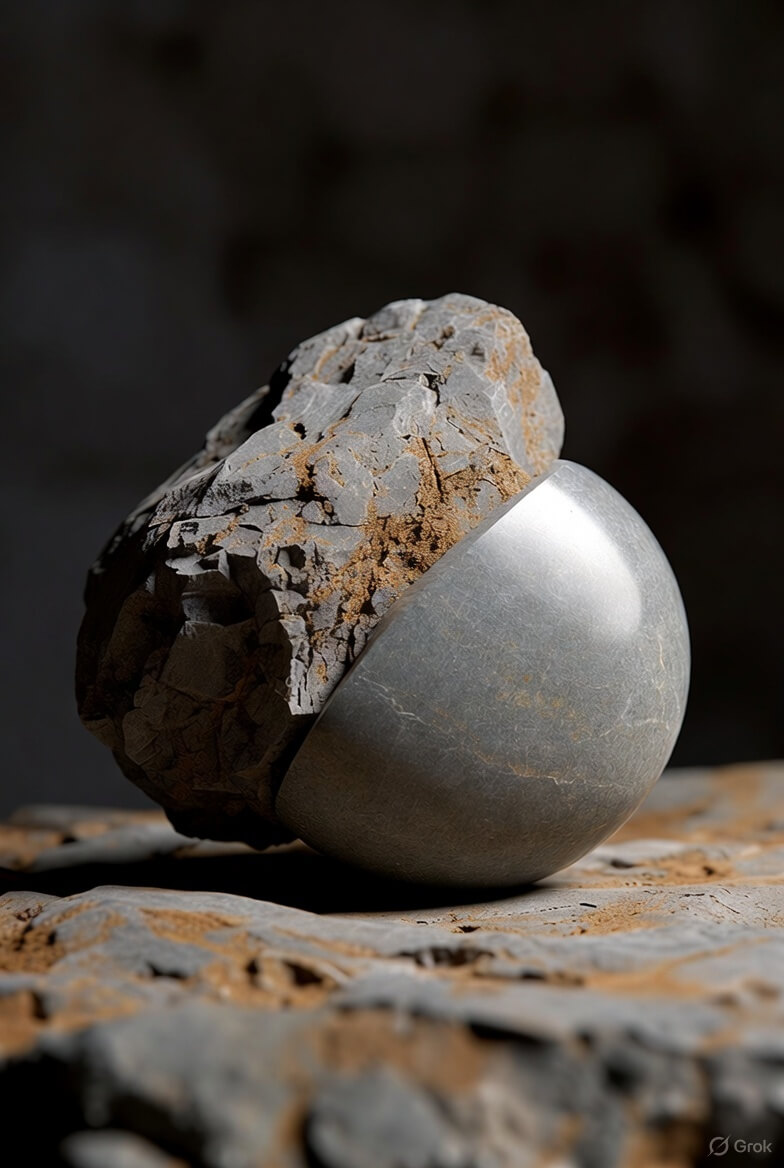
Some stones polish.
Some stones shatter.
Under the same pressure, one person will become sharper, clearer, more aligned. The other will break along lines that were already hidden inside them. Pressure does not create cracks. It exposes them.
This is why two people can face the same darkness.
One finds a way to grow.
The other collapses in on themselves.
And it forces you to ask a second question beneath the first one.
What makes a person the solid stone?
The Catalyst Principle
There is an old story you know well. The story of Saul and David.
A king who had lost his alignment, and a boy who had not yet stepped into his destiny.
People often turn this into a simple tale of bravery.
But beneath the surface it carries one of the most important patterns in human development.
When a system becomes misaligned, a catalyst appears.
Not to punish it.
Not to destroy it.
But to replace the pattern that can no longer support growth.
Saul was not “bad.”
He was out of alignment.
He had lost the inner integrity required to lead.
And so a new pattern emerged from outside the structure.
Someone with clarity.
Someone with coherence.
Someone whose inner architecture could handle the pressure the king no longer could.
David did not defeat Goliath because he was special.
He succeeded because he was aligned.
The stone he carried was solid.
The stone inside him was solid too.
The story is not about kings and giants.
It is about what happens inside a person when the old way of being collapses.
When your inner Saul is no longer fit to lead your life…
a David appears.
A catalyst.
A new direction.
A new internal structure.
But it can only emerge if there is something in you strong enough to carry it.
This principle is universal.
When the old pattern breaks, a new pattern enters.
But only if the internal ground is ready for it.
Which brings us to the question:
Why do some people become that new pattern, while others crumble when the old collapses?
To answer that, we need to look at the nature of contrast itself.
Contrast, Darkness, and Human Growth
If you watch life closely enough, you eventually see a pattern that is hard to ignore.
Darkness does not destroy people.
Fragmentation does.
Darkness is simply contrast. It is pressure, tension, challenge, confusion, loss, and the parts of life we would never choose but somehow end up walking through anyway. Darkness is not a force working against you. It is an environment. A condition.
Some people use it.
Others are overwhelmed by it.
The difference is not in the darkness itself.
The difference is in the structure of the person stepping into it.
When someone is internally aligned, darkness becomes a kind of mirror.
It shows them what is real.
It forces clarity.
It strengthens what is strong and exposes what is weak.
And if they are willing to look, it pushes them into growth they would never have reached in comfort.
But when someone is internally divided, darkness becomes a magnifier of the divide.
It widens the cracks.
It tightens the fear.
It pushes the person deeper into themselves, but not in a way that brings healing.
More like an avalanche collapsing everything inward.
This is why two people can experience the exact same moment:
One comes out wiser.
The other comes out bitter.
One finds meaning.
The other loses themselves.
One transforms the weight into strength.
The other lets the weight define them.
It is not about “deserving.”
It is not about “fate.”
It is not about “good people” being rewarded or “bad people” being punished.
It is about inner architecture.
How the person is built on the inside.
Before we explore that architecture, we have to understand something even deeper:
Growth is not born from the light.
It is born from the interaction between light and darkness.
Light shows what is possible.
Darkness tests what is real.
Together, they shape you into something stronger.
Or they break you.
And that difference leads us directly into the heart of this article:
the nature of the solid stone.
The Architecture of the Solid Stone
If you look closely at the people who grow from darkness, you notice something consistent. They aren’t superhuman. They aren’t fearless. They aren’t immune to pain.
They simply have an inner structure that can carry weight.
A solid stone is not made of perfection.
It’s made of coherence.
Let’s break this down.
1. Self-Honesty: The Foundation
A person who grows is honest with themselves. Not in a harsh or self-critical way, but in a grounded way. They are able to look at their thoughts and feelings without running from them.
They don’t pretend.
They don’t deny.
They don’t rewrite the story to protect their ego.
When something hurts, they admit it.
When something scares them, they acknowledge it.
When they make a mistake, they see it clearly.
This is the first layer of strength.
Self-honesty prevents hidden fractures.
A crack you can see is a crack you can heal.
A crack you hide becomes the place you break.
2. Shadow Integration: Welcoming the Parts We Want to Avoid
People who grow from darkness have a different relationship with their shadow. They don’t fight it. They don’t bury it. They don’t project it onto others.
They turn toward it.
They understand that the shadow is not the enemy. It is the part of them carrying unresolved pain, unmet needs, and unprocessed memories. When you acknowledge those parts, they stop sabotaging you.
Integration isn’t about becoming perfect.
It’s about becoming whole.
A whole person can withstand pressure.
A divided person cannot.
3. Inner Alignment: Words, Actions, and Values Lining Up
A solid stone doesn’t crumble because its parts move together. The same thing is true inside a person.
When your actions match your values, and your words match your intentions, you create stability.
When you live in contradiction, you create stress.
And stress, when buried, creates cracks.
Alignment is not about being rigid.
It’s about being consistent within yourself.
When you act from your truth, pressure pushes you deeper into that truth.
When you act from a lie, pressure pushes you deeper into the lie.
Only one of those leads to growth.
4. Responsibility: Owning Your Story
People who grow from darkness don’t blame the world forever. They don’t hand their power to circumstance. They don’t say “life did this to me” and stop there.
They take responsibility.
Not for everything that happened – but for everything that happens next.
Responsibility is the moment a person becomes the cause instead of the effect.
It is the point where their internal structure begins to harden in the right way.
It is the beginning of resilience.
It is the moment the stone becomes dense enough to hold weight.
5. Awareness: The Element Holding Everything Together
Awareness is the quiet observer inside. The part of you that sees without judgment. The part that catches you before you collapse into old patterns.
Awareness slows everything down.
It gives you room.
It gives you choice.
It gives you perspective.
Without awareness, emotions become storms.
With awareness, emotions become weather.
One passes through you.
The other consumes you.
Awareness is the difference between reacting and responding.
It is the difference between shattering and adapting.
It is the internal pressure valve that keeps the stone from exploding when life gets heavy.
When all of these elements come together, you get a person who can walk into darkness and come out changed, not broken.
Not because the darkness was kind.
Not because they were protected.
Not because they were chosen.
But because their inner structure could hold itself together long enough to transform.
That is the solid stone.
And now that we understand what it takes to grow, we can explore the other path – the cracked stone.
The Cracked Stone (The Fragmentation Path)
If the solid stone is built from coherence, the cracked stone is built from contradiction.
Not intentional contradiction.
Not chosen contradiction.
But the kind a person carries silently inside themselves.
Most people do not break because the world is cruel.
They break because their internal structure cannot distribute the pressure.
Here is what that structure often looks like.
1. Denial and Avoidance
When a person cannot face what they feel, the feeling does not disappear. It goes underground. It becomes pressure that builds inside them over time.
Avoided pain does not heal.
Denied truth does not resolve.
Pushed-away memories do not fade.
They sit underneath the surface, waiting for the moment life becomes heavy enough to split them open.
Avoidance feels safe in the moment.
It becomes dangerous later.
2. Ego Rigidity
Some people cannot adapt because their identity is built on sand.
It is fragile.
Overprotective.
Inflated on the outside and terrified on the inside.
Ego rigidity says:
“I must never be wrong.”
“I must always be seen a certain way.”
“I must defend who I think I am.”
But when pressure comes, rigidity becomes a fault line.
Instead of bending, it snaps.
A person does not break because they are weak.
They break because they cannot afford to loosen their grip.
3. Projection of Shadow
When someone cannot face their own darkness, they see it everywhere else.
Every threat is external.
Every conflict is someone else’s fault.
Every uncomfortable truth is reflected outward.
Projection protects the ego.
But it fractures the self.
If the shadow is always outside you, there is no way to integrate it.
And if there is no integration, there is no strength.
Fragmentation turns every challenge into an enemy.
Which means every enemy becomes another crack.
4. Internal Division
A person becomes fragile when they live in contradiction with themselves.
Wanting one thing, acting out another.
Saying words that don’t match their intentions.
Carrying values they do not live by.
Living a story that is not true.
Division creates internal tension.
Internal tension creates micro-fractures.
Micro-fractures multiply under pressure.
When the weight comes, they do not have enough unity inside to hold themselves together.
5. Lack of Awareness
Without awareness, everything feels personal.
Everything feels immediate.
Everything feels total.
A feeling becomes a fact.
A thought becomes a truth.
A moment becomes an identity.
There is no space.
No pause.
No observer.
Only reaction.
A mind without awareness is like a stone full of air pockets.
It cannot support itself.
Pressure finds every empty space, and the collapse feels sudden even though it was forming for years.
None of these traits make someone “bad.”
They make someone unprepared.
A cracked stone is not doomed.
It simply has not yet learned how to hold its own weight.
The good news is that these cracks are not permanent.
They can be healed.
They can be closed.
They can be transformed.
And that is where the real meaning of “good vs bad” begins to shift into something far more human, far more universal, and far more accurate.
Systems Thinking: The Real Meaning of Good vs Bad
At this point in the journey, something becomes clear.
The old language of “good” and “bad” doesn’t describe what’s really happening inside a person.
Those words are too blunt.
Too moral.
Too shaped by culture, fear, and tradition.
In reality, what we call “good” and “bad” is better understood as alignment and fragmentation.
Let’s look at this from the systems perspective.
1. Alignment: The System That Moves Toward Wholeness
When a person is aligned, their inner parts are working together.
Their thoughts match their values.
Their actions match their intentions.
Their emotions and awareness communicate instead of compete.
An aligned person is not perfect,
but they are connected.
And connection creates coherence.
Coherence creates resilience.
Resilience creates growth.
This is what many traditions once called “good,”
but it is not about morality.
It is about structure.
2. Fragmentation: The System That Moves Toward Collapse
Fragmentation is the state where the inner world is divided.
Part of you wants change.
Part of you fears it.
Part of you seeks truth.
Part of you hides from it.
Part of you wants connection.
Part of you pushes people away.
This is not “bad” in a moral sense.
It is simply a system out of sync with itself.
Fragmentation creates instability.
Instability creates cracks.
Cracks create collapse.
When pressure hits, the system breaks from the inside.
Not because the person is bad.
But because the structure is not unified enough to carry weight.
3. Why People Mistake Structure for Morality
For thousands of years, humans have confused inner structure with moral judgment.
A person who withstands darkness is called “good.”
A person who collapses under it is called “bad.”
But the truth is much simpler:
Some people are aligned enough to transform.
Some people are fragmented enough to break.
Pressure reveals the architecture.
It does not assign moral value.
This is why the saying makes sense:
“We can make a good man great.
But we cannot make a bad man good.”
Because “good” simply meant “aligned.”
And “bad” meant “fragmented.”
You cannot build greatness on a fractured foundation.
You must first unify the structure.
4. Another Look at God and the Devil
Earlier, we explored the idea that God represents integration
and the Devil represents fragmentation.
This is not about religion.
It is about direction.
Integration moves you toward wholeness.
Fragmentation moves you toward collapse.
When someone does harm “in the name of God,”
they are acting from fragmentation.
When someone finds healing “in the darkest moment,”
they are acting from alignment.
The labels do not matter.
The structure does.
5. The Real Meaning of Growth Through Darkness
Darkness does not make you grow or destroy you.
It amplifies the direction you are already moving.
If you are internally aligned, darkness becomes a forge.
If you are internally fragmented, darkness becomes a fault line.
This is why two people facing the same moment can walk away with two completely different outcomes.
One finds strength.
One loses stability.
Not because of destiny.
Not because of identity.
But because of structure.
Why Darkness Helps One Person and Destroys Another
Now we can finally return to the opening question with clarity.
Why do some people grow from darkness while others are destroyed by it?
Because darkness does not decide the outcome.
The person does.
Darkness is the environment.
The internal structure is the filter.
And the filter determines what the darkness becomes.
Let’s break this down in a straightforward way.
1. For the aligned person, darkness becomes fuel
When a person is internally coherent, darkness activates their deeper capacities.
- Self-honesty shows them what needs to change.
- Shadow integration gives them access to hidden strength.
- Alignment keeps them steady under the weight.
- Responsibility turns challenge into direction.
- Awareness helps them navigate the emotional landscape without losing themselves.
For them, darkness becomes information.
It becomes friction.
It becomes feedback.
It becomes a catalyst for growth.
Pressure strengthens them because there are no hidden cracks for it to slip into.
2. For the fragmented person, darkness becomes destabilizing
When someone is internally divided, darkness does not expand their capacity.
It overwhelms their lack of cohesion.
- Denial turns pressure into panic.
- Ego rigidity turns tension into collapse.
- Shadow projection turns challenge into conflict.
- Internal division turns decisions into confusion.
- Lack of awareness turns emotions into storms.
Darkness magnifies every fracture.
It exposes what was already broken.
It amplifies what was already avoided.
It destabilizes what was already fragile.
Pressure does not destroy them.
The pressure simply finds the places where they were already breaking.
3. Darkness does not choose who grows. The person chooses how they meet it.
This is the deepest truth hidden beneath religious language, mythic symbolism, and psychological theory.
Darkness is not the teacher.
Alignment is.
Darkness is not the enemy.
Fragmentation is.
Darkness is not the solution.
Integration is.
Growth happens when a person has the internal structure to interpret darkness correctly.
Destruction happens when a person does not yet have that structure.
Both paths reveal the same message:
You cannot avoid the darkness,
but you can choose who you become inside it.
4. The opening question answered
At the beginning, we asked:
“Why do some people grow from darkness while others are destroyed by it?”
The answer is simple, but not easy.
A person grows when their inner architecture is coherent enough to transform pressure into strength.
A person collapses when fragmentation turns pressure into collapse.
Darkness is not the defining force.
Darkness is the revealing force.
It does not change you.
It shows you.
And that realization leads us naturally into the final section, where we explore how someone can begin becoming the solid stone themselves.
Becoming the Solid Stone
By now, the idea is clear.
A solid stone is not a person who has never struggled.
It is a person who has learned how to hold their own weight.
The question is not
“How do I avoid darkness?”
but
“How do I build myself in a way that darkness cannot break me?”
This section is not advice.
It is not a list of steps.
Think of it as a quiet invitation.
A set of directions you can walk toward in your own time.
1. Start With Small Honesty
Strength begins with honesty.
Not the dramatic kind.
The small, uncomfortable moments of truth you usually skip past.
“I am overwhelmed.”
“I am scared.”
“I am avoiding something.”
“I want something different.”
You do not have to fix anything.
Just see it.
A stone becomes solid not by being flawless,
but by having no hidden chambers inside it.
Small honesty closes the gaps.
2. Let Your Shadow Speak
Most people spend their whole lives trying not to feel something.
But whatever you refuse to feel… rules you.
Shadow integration is not a wild ritual.
It is simply letting the part of you that hurts have a voice.
“What are you trying to tell me?”
“What do you need?”
“What are you afraid of?”
When you listen, the shadow softens.
When you welcome it, it becomes part of your strength.
A stone with all its pieces included is stronger than one missing a chunk.
3. Move Toward Alignment, Not Perfection
Alignment is simple.
Say what you mean.
Do what you believe.
Act in a way that reflects who you actually are.
Not perfectly.
Just consistently.
Perfection is fragile.
Alignment is resilient.
Every time your outer life matches your inner values,
your internal structure becomes a little more stable.
4. Take Responsibility For The One Thing You Can Control
You cannot choose the darkness you walk through.
But you can choose the way you meet it.
Responsibility does not mean blaming yourself.
It means taking ownership of your responses.
“What can I do with this?”
“How can I grow from this?”
“What does this reveal about me?”
Responsibility is how the stone gains weight.
It is how you become someone who can carry more without cracking.
5. Make Awareness Your Home Base
Every moment of awareness strengthens you.
Taking one breath before reacting.
Pausing for a second longer than usual.
Watching your thoughts instead of obeying them.
Noticing your feelings without becoming them.
This is the quiet work that builds endurance.
It is the internal space that prevents collapse.
It is the difference between being pulled apart and holding together.
Awareness is the invisible thread that ties the whole structure into one piece.
In the end, becoming the solid stone is not about being unbreakable.
It is about being whole enough that even if you crack, you can put yourself back together again.
This is what makes growth possible.
This is what makes resilience real.
This is what turns darkness into a teacher instead of a threat.
And it is available to anyone who begins the work of coherence.
Reflection
We began with a question:
Why do some people grow from darkness while others are destroyed by it?
After walking through the nature of alignment, fragmentation, shadow, and internal structure, the answer is much clearer now.
Darkness never chooses who to break.
Darkness simply reveals who is ready to grow.
Some people walk through it with enough internal coherence to let the pressure shape them.
Others walk through it carrying cracks they have tried to hide for too long.
Neither path defines a person forever.
The solid stone was not always solid.
The cracked stone is not beyond repair.
Growth is not reserved for the chosen.
Strength is not inherited.
Resilience is not a personality trait.
It is the result of small choices made honestly over time.
It is the quiet courage to turn inward instead of running outward.
It is the willingness to meet the parts of yourself you once avoided.
It is the decision to build, piece by piece, the internal structure that can carry your own weight.
Darkness will come.
It always does.
But who you become inside it is not written anywhere.
It isn’t fate.
It isn’t predetermined.
It isn’t fixed.
It is shaped by the work you do in the spaces no one sees.
And in that work, you discover something important.
You were never meant to avoid the pressure.
You were meant to become strong enough to withstand it.
Not through hardness,
but through coherence.
Not through perfection,
but through honesty.
Not through fearlessness,
but through awareness.
Because in the end, the stone doesn’t become solid by resisting the weight.
It becomes solid by becoming whole.
And once you become whole,
darkness is no longer something that destroys you.
It becomes something that reveals you.