
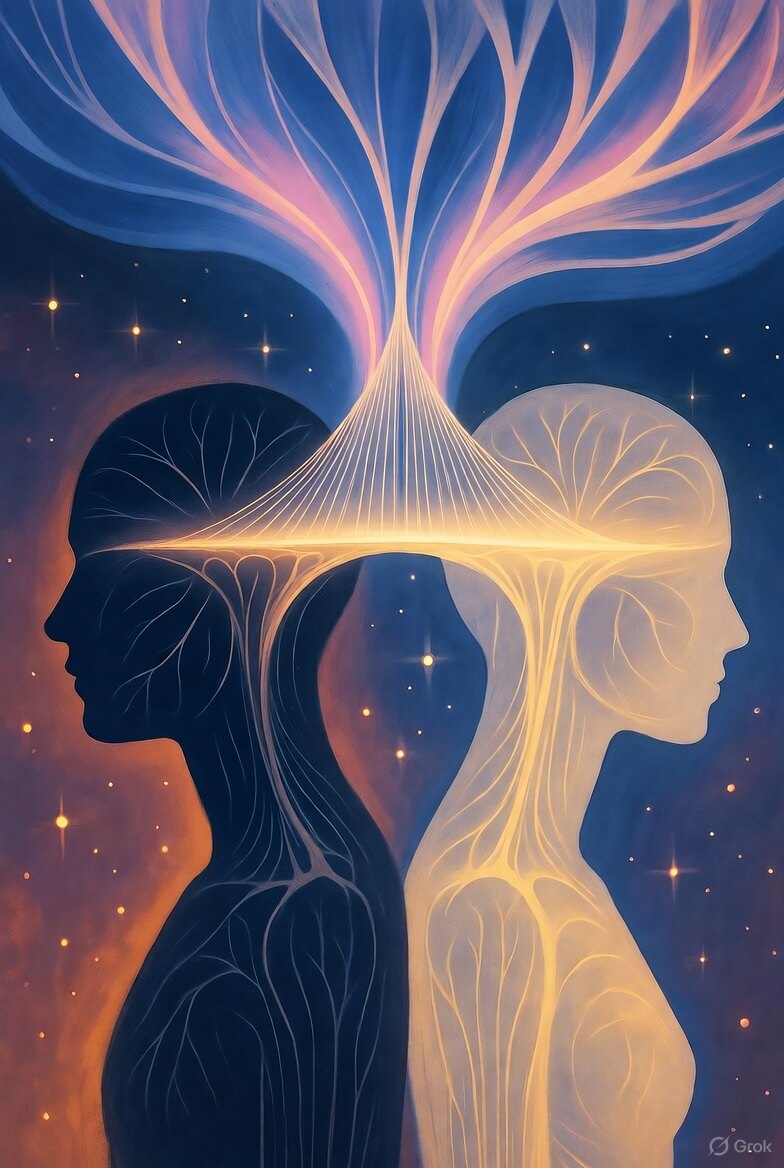
The Invisible Divide
If the mind were a landscape, the conscious and subconscious would be its two great continents, distinct in character, yet joined beneath the surface by a single foundation. Between them lies what most people never see: the bridge, a living pathway of awareness where thought transforms into feeling, and feeling shapes reality.
For centuries, people have tried to conquer the subconscious, to command it like an unruly servant. But the bridge was never meant to be controlled; it was meant to be crossed. The true mastery of mind isn’t domination; it’s connection.
This bridge is subtle, often invisible. It’s not made of logic or language, but of resonance, that quiet vibration we feel when our thoughts, emotions, and actions suddenly align. You can sense it in moments of deep creativity, meditation, or pure intuition, times when the conscious mind stops trying, and something deeper begins to move through you.
The crossing doesn’t happen through effort; it happens through coherence. When intention (the direction of thought) and emotion (the energy of being) come into harmony, the bridge activates. The conscious begins to inform the subconscious directly, and the subconscious, in turn, begins to reveal its wisdom.
This is the point where the internal divide dissolves, not because one side wins, but because both recognize they’ve been speaking the same language all along.
The bridge isn’t built, it’s remembered.
The Crossing Point
The bridge between conscious and subconscious isn’t a place; it’s a state.
It appears in that subtle moment between thought and emotion, between the spark of awareness and the ripple of feeling that follows. Most people move through this space unconsciously every day; it’s the pause before reaction, the breath before speech, the quiet before creativity flows.
This is the crossing point, the threshold of awareness. It’s where intention becomes energy.
When you think of a goal, you’re shaping a pattern in the conscious mind, a thought form. But for that pattern to manifest or create internal change, it must pass through this threshold. It’s like encoding a message for delivery. The subconscious is always listening, but it doesn’t receive words; it receives frequency.
That’s why emotion is the passport that allows thought to cross the bridge.
When a thought carries genuine feeling, curiosity, excitement, love, or even grief, it gains weight, resonance, and life. The subconscious recognises this vibration as authentic and begins to work with it.
The crossing point, then, is not found through thinking harder, it’s found through feeling deeper.
And it’s always there, in every decision, every pause, every moment you align your inner world with outer action.
When awareness lingers in that in-between space, no longer thinking, not yet reacting, the bridge lights up.
It’s here, in this silent current, that conscious direction meets subconscious power.
The Mechanics of Connection
For all its mystery, the bridge between conscious and subconscious isn’t random; it follows a clear set of mechanics. It’s less like a mystical veil and more like an interface, where the precision of the conscious meets the pattern-based intelligence of the subconscious.
Three main mechanisms keep the bridge open: emotion, repetition, and visualization.
Emotion is the fuel.
It provides the energetic charge that makes information real to the subconscious. The stronger and more coherent the emotion, meaning it feels true rather than forced, the more deeply it imprints into the subconscious field.
That’s why affirmations only work when you feel them. The subconscious doesn’t respond to empty words, it responds to vibration.
Repetition is the programming language.
Each time a thought is paired with emotion, the neural network strengthens. The brain rewires itself through consistency, encoding the new pattern as default reality. To the subconscious, repetition equals safety. What’s familiar becomes what’s real.
Visualisation is the bridge’s sensory translation system.
It turns abstract thought into imagery that the subconscious can interact with. Every clear image with emotional weight becomes an instruction, not a wish, but a blueprint. The subconscious, in turn, uses emotion and memory to begin manifesting that blueprint in both internal perception and external behaviour.
When these three work in harmony, a feedback loop forms: thought generates emotion, emotion reinforces belief, and belief shapes perception, which then influences new thought. This cycle creates a self-sustaining resonance between conscious intent and subconscious execution.
In energetic terms, this is coherence, the point where mental, emotional, and physiological frequencies align. Studies in heart-brain synchronization show that when coherence is reached, intuition heightens, decision-making becomes clearer, and creativity flows effortlessly.
So the mechanics of connection aren’t theoretical; they’re experiential.
When coherence is achieved, the bridge doesn’t just open; it stays open.
The Flow of Information
Once the bridge between the conscious and subconscious is open, information doesn’t just travel one way, it flows both directions. The conscious mind sends new instructions, and the subconscious responds with feedback, sensations, impulses, dreams, and intuitive nudges that reveal how the message has been received.
It’s not a hierarchy; it’s a conversation.
The conscious communicates through focus and intention, shaping clear mental and emotional patterns. The subconscious responds through feeling and synchronicity, subtle reflections that appear in both inner awareness and outer experience. When the two are aligned, you begin noticing life responding to your internal state: a sense of timing that feels precise, opportunities that appear at just the right moment, ideas that unfold naturally.
That’s the bridge at work; resonance feedback.
Every thought you send carries an energetic signature. When it meets the subconscious, it’s either absorbed (if the signal matches a safe, familiar frequency) or deflected (if it conflicts with existing programming). The subconscious then mirrors that back through the body, as emotion, tension, or intuition, signaling whether it’s aligned or not.
The more we tune in to those responses, the clearer the communication becomes. What feels like resistance isn’t failure, it’s feedback, a message saying, “Something in this pattern still needs alignment.”
When coherence is restored, the feedback loop stabilizes, like two instruments finding harmony after a few tuning adjustments.
This is also how creativity and intuition function. The conscious mind poses the question; the subconscious delivers the answer, not through logic, but through imagery, inspiration, and feeling. It’s a continuous data exchange that runs faster than thought, bridging analysis with instinct.
And that’s where the real magic happens: when both minds recognize that the bridge isn’t a one-time crossing, but an ongoing dance of information, each movement refining the other until both are perfectly in tune.
The Guardian of the Gate
Every bridge needs a guardian, not to block the way, but to make sure only the right travelers pass.
In the mind, that guardian is the subconscious defense system, the part that filters incoming information and decides what’s allowed to cross into deeper programming.
Its purpose isn’t to limit you; it’s to protect the system from chaos. The subconscious doesn’t deal in “good” or “bad,” only in safe or unsafe. Its job is to preserve continuity, even if that continuity means holding on to outdated patterns.
When you introduce a new belief or intention that contradicts old conditioning, this guardian steps forward. You might feel resistance, doubt, procrastination, or emotional fatigue, all signs that the subconscious is testing the new signal for safety.
It’s easy to mistake that as failure, but in truth, it’s dialogue. The guardian isn’t saying “no,” it’s asking, “Are you sure this is safe? Can I trust this new frequency?”
This is why force never works. The subconscious doesn’t open through control; it opens through reassurance. Compassion, repetition, and emotional safety are the keys that ease the gate open.
Every time you meet resistance with patience instead of frustration, you send a new message: “This change isn’t a threat; it’s an evolution.”
The subconscious learns from that consistency and begins to relax its defenses.
Think of it like a bridge guarded by an ancient being of instinct and memory, it respects truth, not urgency. When the conscious mind speaks from authenticity and emotional coherence, the guardian steps aside and allows the passage.
And when that happens, you’re no longer forcing alignment, you’re earning it.
Over time, the guardian transforms from a gatekeeper into an ally, reminding you not to rush transformation but to cultivate it. Because every frequency you send through that bridge becomes part of who you are.
“This concept has been echoed throughout spiritual and psychological traditions, from esoteric texts describing the Gatekeeper of Heaven to modern understandings of subconscious defence mechanisms. In both, the message remains: your awareness is the true guardian of your inner world.”
Integration: Walking Both Worlds
Once the guardian relaxes its grip, the bridge becomes a living pathway, not something you cross once, but something you walk daily. Integration means no longer living from the conscious or the subconscious alone, but from their harmony.
In this state, awareness becomes the conductor of the orchestra, the conscious mind provides direction, while the subconscious carries rhythm, memory, and depth. Together they create a symphony of action that feels effortless, fluid, and true.
This isn’t about control, it’s about trust. You begin to sense what the body and the subconscious are telling you without judgment, and you act with clarity, not compulsion. Decisions become intuitive yet grounded; emotion becomes information rather than interference.
The real integration happens when you start to see that both the conscious and subconscious are expressions of one greater field, the self-aware energy that animates both thought and feeling. The bridge then isn’t a structure; it’s an awareness, an inner alignment that allows you to move seamlessly between logic and intuition, intention and surrender.
It’s a quiet mastery.
One that doesn’t shout or struggle, but simply flows, like a river merging into the sea, no longer separate, yet never lost.
When you reach this point, life itself becomes the practice, every moment an opportunity to tune, align, and remember that you are not two minds at odds, but one awareness exploring itself through different frequencies.
The Living Bridge
The bridge between the conscious and subconscious isn’t a destination; it’s a relationship.
Each thought, emotion, and act of awareness adds new architecture to it, refining its design through experience. The more you walk it, the more stable it becomes.
Over time, you stop asking which side of the bridge you’re on, because both are you. The conscious learns to speak in feeling; the subconscious learns to listen through meaning. The two stop debating and begin dancing, moving as one flow of intent, emotion, and will.
This is the heart of true coherence, when what you think, feel, and do are all singing the same frequency. From here, transformation no longer feels forced. It unfolds naturally, as if life itself is breathing through you, shaping form through flow.
So remember:
You are the architect, the traveller, and the bridge itself, the living connection between seen and unseen, thought and energy, form and essence.
And when you realise that… the river doesn’t just run through you.
You become the river, flowing freely through the field of consciousness, harmonising every note back into unity.